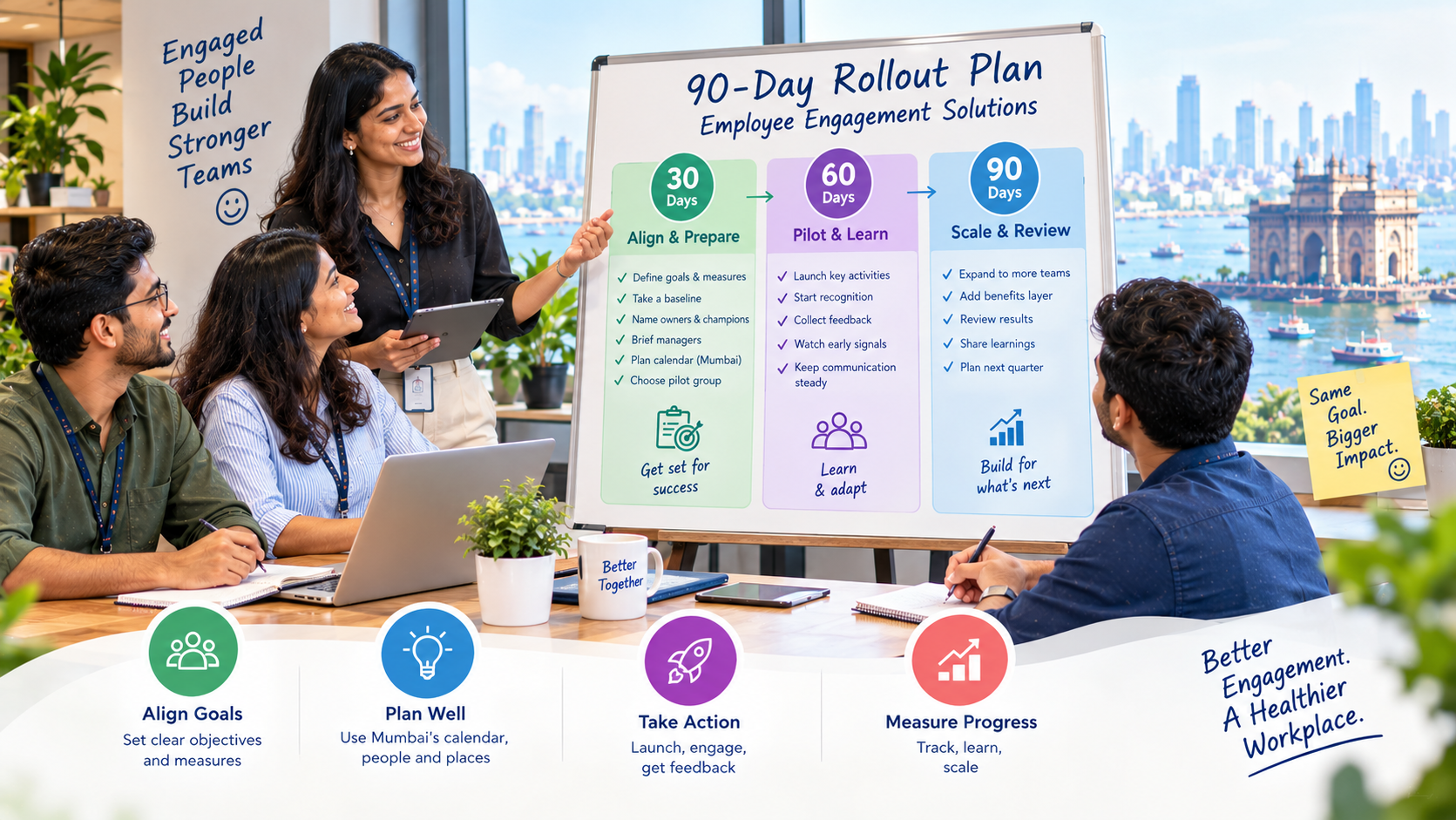
Employee Engagement Solutions in Mumbai: A 30-60-90 Day Rollout Plan
Choosing among employee engagement solutions in Mumbai gets all the attention. Far less is said about what to do in the first quarter after you have chosen one. Yet this is where many programmes succeed or quietly fail. A good solution launched badly produces thin turnout, confused managers and a disappointing review three months later.
This guide gives you a 30-60-90 day rollout plan: what to do in each stage, who owns what and how to judge whether you are on track.
Why the First 90 Days Matter
Engagement improves slowly. Gallup’s global research puts only around a fifth of employees as engaged at work, which shows how hard it is to move. You will not see a transformation in 90 days, but you can build the habits, systems and early signals that make improvement possible. The first quarter should aim to launch properly, learn quickly and set up a rhythm that continues.
Days 1 to 30: Align and Prepare
Define the problem and the measures
Write down what you are trying to improve in specific terms: for example, participation that drops after the first event, new hires fading in the first months or managers who do not recognise their teams. Choose three or four simple measures, such as repeat participation, opt-in rate for optional activities, a short pulse question and voluntary exits.
Take a baseline
Record where you start. Note recent participation, any survey results, attrition and a few comments from employees. Without a baseline, you cannot tell later whether anything has changed.
Name the owners
You need an HR owner who can give consistent time each week, a senior sponsor who will back the programme visibly and a named contact at the provider. Add a few volunteer champions across teams, including frontline and hybrid staff.
Brief the managers
Managers decide whether employees take part. Give them a short briefing on what is coming, why it matters and what you need from them. Research on employee communication finds that immediate supervisors are the most trusted source of information, so their support matters.
Plan the calendar around Mumbai
Map the next three months against the weather and festivals. Avoid outdoor plans in heavy monsoon weeks and plan around Ganeshotsav, Navratri and Diwali if they fall in your window. Choose working-hours formats, since long commutes make after-hours events unreliable.
Choose a pilot group
Pick one team or location that is representative but manageable, and include some hybrid or shift staff so you learn how it works for them.
Days 31 to 60: Pilot and Learn
Launch a small number of activities
Run two or three activities with your pilot group, not twenty. Mix formats: for example, one recognition moment, one shared activity and one communication touchpoint. Announce them clearly, with date, time and what to expect.
Start simple recognition
Introduce specific, timely recognition from managers and peers. Gallup and Workhuman’s research found well-recognized employees were 45% less likely to have left their jobs after two years, so it is one of the highest-value early habits.
Gather feedback every week
After each activity, ask two or three quick questions: did it work, what would you change, would you come again? Review the answers with your provider weekly, and adjust quickly. A pilot exists to find what does not work.
Watch the early signals
Look at who turned up, who did not and why. Check whether hybrid and shift staff were able to take part. Notice whether managers encouraged their teams. Fix obvious problems, such as timing or communication, straight away.
Keep communication steady
Send a short, regular update about what is happening and what is next. Consistency builds trust. ICE’s Inform pillar is built around this kind of ongoing, clear communication.
Days 61 to 90: Scale and Review
Expand carefully
Extend what worked to more teams and locations. Adapt formats for different groups, such as shorter versions for shift staff and virtual options for remote days. Do not simply copy the pilot; adjust it.
Add a benefits or rewards layer if it fits
If your solution includes benefits or privileges, introduce them now, with a clear explanation of how to use them. Awareness decides usage. A benefits report found 73% of employees want more education on the benefits they already have.
Hold a 90-day review
Compare your baseline to where you are. Review participation, repeat attendance, feedback, manager involvement and the pulse question. Share a short summary with leaders and employees: what you did, what you learned and what comes next. Decide what to keep, change or stop, and plan the next quarter.
What Good Looks Like at 90 Days
Participation is steady or growing across repeat activities, not just the first one. Employees from different teams and shifts are taking part. Managers are visibly supporting the programme. Feedback is specific and mostly positive, and you have clear ideas for improvement. You have a calendar for the next quarter and a simple way to report progress. You should not expect big shifts in engagement scores yet.
Mistakes to Avoid
The most common mistake is launching everything at once. The second is skipping the baseline. The third is leaving managers out. The fourth is ignoring Mumbai’s weather and festival calendar. The fifth is measuring only attendance at the first event. The sixth is declaring success or failure after a few weeks.
Getting Support During the Rollout
If HR is stretched, a partner can run the calendar, communication and measurement while you keep strategic control. ICE builds employee engagement solutions in Mumbai through three connected pillars: Inform for communication, Connect for experiences and wellness and Reward for benefits and privileges. For more reading, see how to build an employee engagement strategy, where HR should start when employee engagement is low and how to make employee engagement activities work for everyone. To plan a rollout for your own team, contact ICE.
Follow ICE on LinkedIn, Instagram, Facebook, and YouTube for more HR and engagement resources.