Employee Engagement Activities in Mumbai: A Year-Round Plan That People Actually Join
Plan employee engagement activities in Mumbai that people actually join. A year-round guide by goal, season and workforce type.
Planning employee engagement activities in Mumbai is harder than it looks on paper. A cricket tournament that works in February gets washed out in July. A festive lunch that delights one team means nothing to a night-shift team. An after-work event competes with a two-hour commute home. HR teams here often end up with a calendar that looks full but delivers thin turnout, and the reason is usually timing and fit, not a lack of ideas.
This guide gives you a practical way to choose activities by goal, a year-round plan shaped by Mumbai’s monsoon and festival seasons, and ways to match activities to different kinds of workforces.
What Makes Employee Engagement Activities in Mumbai Work (or Fail)
The best activity is the one people choose to join, not the one that looks impressive in a proposal. Three things decide whether an activity lands in Mumbai. The first is time: activities held during the workday, or at a lunch hour, get far better participation than after-hours events, because commutes here already eat into evenings. The second is weather and logistics: a plan that ignores monsoon waterlogging and train disruption will keep getting cancelled. The third is relevance: a mixed workforce of desk staff, frontline staff and hybrid employees will not all respond to the same format.
Engagement overall remains a challenge. Gallup’s global research puts only around a fifth of employees as engaged at work, which is a reminder that one-off events rarely change the picture. Consistent, well-matched activities across the year do.
Choose Activities by Goal, Not by Trend
Before booking anything, decide what the activity is meant to do. Each goal suits a different kind of activity.
For connection
Cross-team lunches, interest-based clubs (reading, running, music, cooking) and buddy pairings between departments help people who never normally work together build a relationship. These cost little and tend to last because they are driven by shared interest.
For recognition
Peer-nominated shout-outs, a monthly “unsung contributor” spotlight and milestone celebrations make sure good work gets noticed. Gallup and Workhuman’s research found well-recognized employees were 45% less likely to have left their jobs after two years, so recognition deserves a permanent place on the calendar, not just an annual awards night.
For learning
Employee-led skill swaps, lunch-and-learns and short external workshops give people a reason to attend that is not just social. They also surface talent that managers do not always see.
For wellness
Guided stretching, yoga, walking challenges and mindfulness breaks give people energy during demanding stretches. They work best inside the workday.
For fun and friendly competition
Quiz nights, box cricket, carrom and board-game tournaments, and inter-department leagues create energy and a sense of team identity. Keep them genuinely optional.
For purpose
Volunteering days, community drives and cleanups give teams a shared cause beyond the office, which builds a different kind of bond from a game.
A Year-Round Calendar for Mumbai Offices
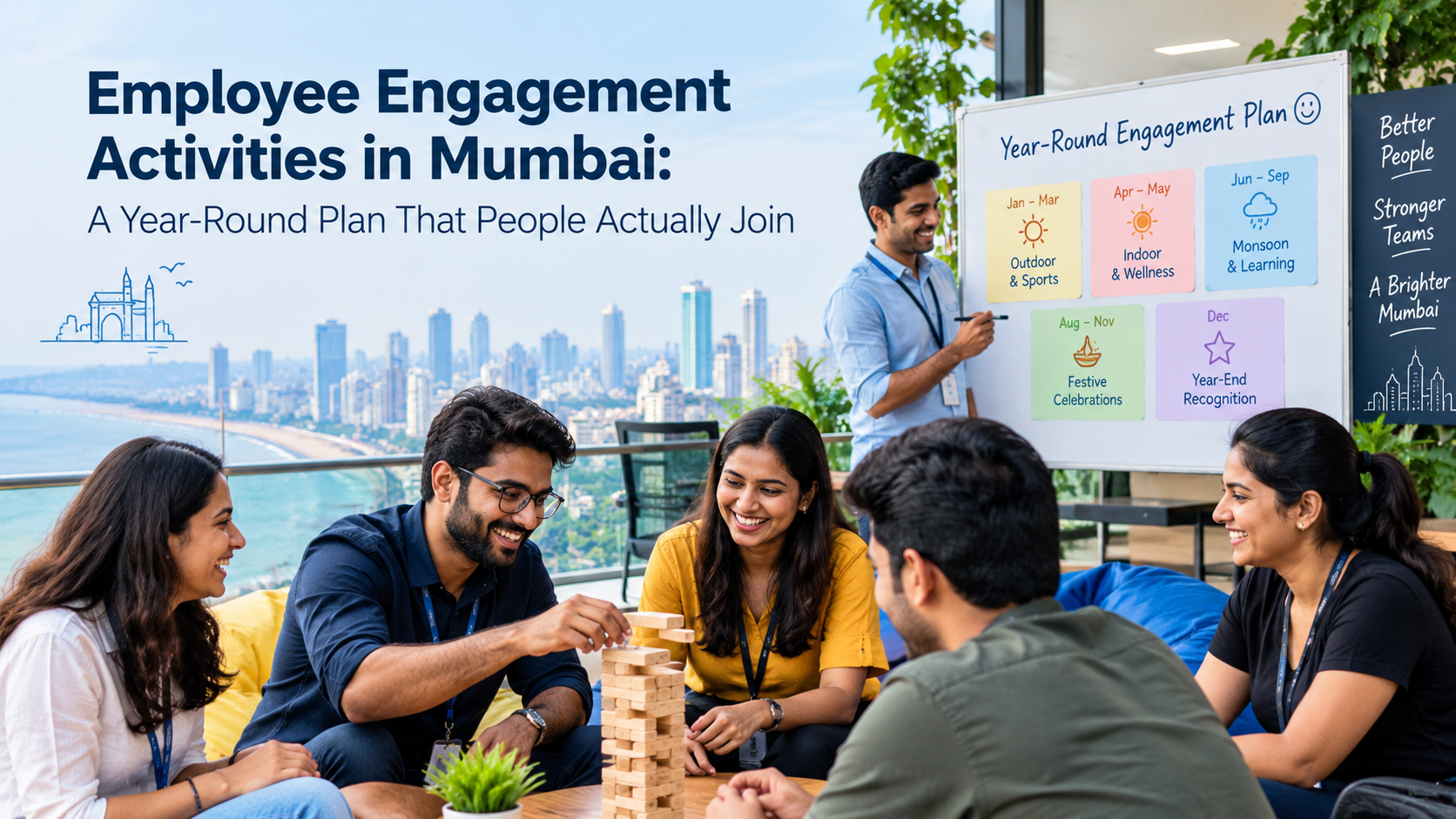
Mumbai’s weather and festival seasons give the year a natural rhythm. Dates shift each year, so treat these as typical windows.
January to March: the strongest outdoor window. Weather is comfortable, so this is the best time for outdoor team days, sports leagues, walking challenges and larger offsites. It is also a good moment to kick off the year’s recognition programme and gather ideas from employees on what they want.
April to May: heat and year-end closing for many companies. Shift to lighter, shorter, indoor formats, such as lunch-hour games, skill swaps and wellness breaks. Avoid midday outdoor events.
June to September: monsoon. Plan indoor and hybrid-friendly activities, and keep a flexible fallback for heavy-rain days when travel is disrupted. This is a good window for learning sessions, quizzes, clubs and digital recognition. Build in permission to work from home or leave early during flooding, because an activity nobody can reach is wasted.
Late August to November: the festive season. Ganeshotsav, Navratri and Diwali give natural reasons to bring people together through decoration contests, shared meals, cultural showcases and small gestures of appreciation. Rotate which festivals get the largest celebration, and make sure other communities’ festivals get genuine acknowledgement as well.
December: year-end. Recognise the year’s contributions, run a wins round-up, and ask employees what they want from next year’s calendar.
Matching Activities to Your Workforce
Desk-based and tech teams
Hackathons, gaming tournaments, skill swaps and interest clubs tend to draw strong voluntary turnout. Short guided stretch or movement breaks help with long hours at a screen.
Hybrid teams
Design for both groups at once. Anchor larger activities to in-office days, but run recognition, quizzes and learning sessions in formats that work equally well remotely, so that remote-day employees are not left with the leftovers.
Frontline and shift-based teams
Schedule across shifts, run shorter formats, and use mobile-first communication to announce activities, since many of these employees do not read email at a desk.
Smaller companies and startups
Low-cost, high-frequency touches work best: specific recognition, leadership office hours, monthly skill swaps and transparent updates. You do not need a large budget to start.
How to Run Activities So Participation Holds
Hold activities in work hours wherever you can. Make them genuinely optional, because forced fun backfires. Ask for feedback after each one and change the next based on it. Rotate formats so the calendar does not feel repetitive. Announce the plan for the quarter early, so people can attend without rearranging their commute. And get managers to take part and encourage their teams, since employees look to their manager for permission to spend time on it.
How to Measure Whether Activities Are Working
Attendance at a single event tells you very little. Look instead at repeat participation across several activities and quarters, whether people sign up without reminders, whether employees start suggesting ideas themselves, and feedback quality after each activity. A steady or growing trend over two to three quarters is the signal that your programme is working.
Common Mistakes With Employee Engagement Activities in Mumbai
The most common mistake is running the same format every quarter until it feels like an obligation. The second is scheduling everything after hours and then wondering why turnout is poor. The third is ignoring the monsoon, so plans keep collapsing. The fourth is treating engagement as events only, when communication, recognition and benefits shape how those events are received. The fifth is measuring only headcount.
Getting Help Running a Year-Round Programme
Many HR teams can plan one good event. Sustaining a full-year calendar alongside core HR work is the hard part. ICE’s Connect pillar is built around recurring on-ground and hybrid experiences, supported by Inform so activities are announced and followed up clearly, and Reward so benefits and privileges reinforce them. For more guidance, read how to make employee engagement activities work for everyone, where HR should start when employee engagement is low and why strong company culture starts with everyday experiences. If you want a calendar built for your office, get in touch with ICE.
Follow ICE on LinkedIn, Instagram, Facebook, and YouTube for more HR and engagement resources.