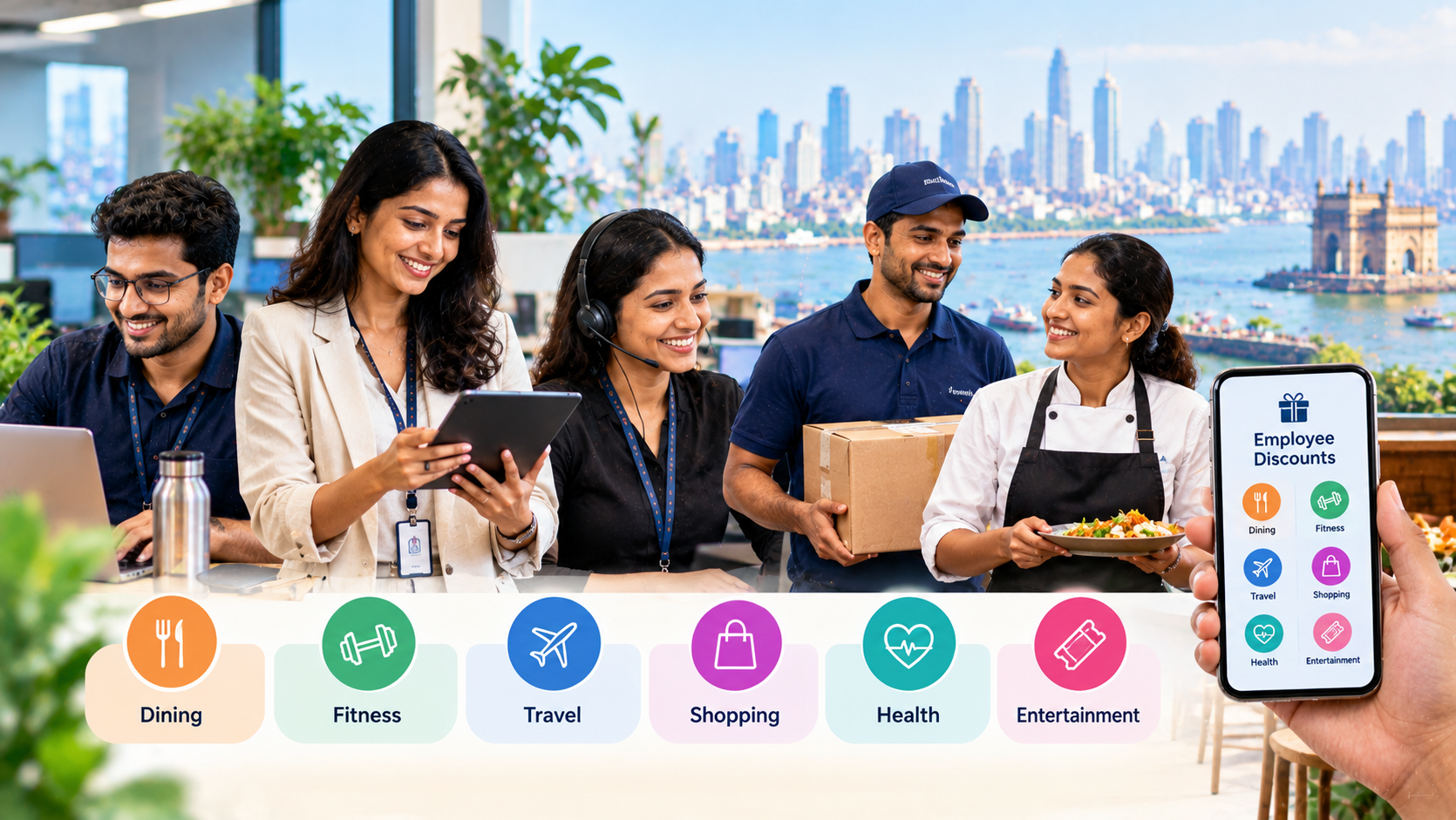
Employee Discount Program in Mumbai: What to Include for IT, BFSI, BPO and Retail Teams
A discount at a café near an IT park is great for a software engineer in Powai. It is useless for a night-shift agent in Malad who finishes at 4 am, or for a retail employee without a smartphone plan that supports a redemption app. This is the problem with most generic perks. An employee discount program in Mumbai works when it is shaped around who the employees are, when they work and where they spend their time.
This guide shows what to prioritise for the main workforce types in Mumbai, so your program reflects your people and not a generic partner list.
Why Industry Changes What an Employee Discount Program in Mumbai Should Offer
Workforces differ in hours, income, devices, commute patterns and family situations. A BFSI professional with a long week and a family needs different offers from a young tech employee or a shift worker. The best programs start with a simple question: when and where does this group actually spend?
Employees also want something that fits their lives. A Glassdoor survey found that 79% of employees would prefer new or additional benefits over a straight pay increase, which makes relevance the deciding factor between a valued perk and an ignored one.
IT and Technology Teams
Who they are. Often younger, hybrid, screen-heavy and spread across Powai, Goregaon, Malad, Airoli and parts of Navi Mumbai and Thane.
What they value. Food delivery and dining near the office, gyms and fitness classes, streaming and entertainment, weekend getaways, learning platforms and wellness services.
What to prioritise. Fitness and wellness offers matter here. Research from a corporate wellness provider found that 89% of employees say they perform better when they can prioritise their wellbeing, and 90% reported experiencing burnout in the past year, which is a good argument for including fitness, mental wellbeing and sleep-related offers. Add delivery and quick-service dining for hybrid days at home.
Redemption. An app or digital code works well, because this group is comfortable with it. Make sure it works for remote days too.
BFSI, Consulting and Professional Services
Who they are. Long hours, formal environments, many employees with families, concentrated in BKC, Lower Parel, Nariman Point and Fort.
What they value. Premium dining for family occasions, family health checkups and diagnostics, travel and short breaks, fitness and yoga, children’s activities and wellness or spa services.
What to prioritise. Offers that work on weekends and around long working weeks, and benefits that extend to family members. Health and travel privileges tend to matter more here than casual dining discounts.
Redemption. Professional, easy and discreet. A card or QR code that works without extra steps suits a time-pressed audience.
BPO and Shift-Based Teams
Who they are. Round-the-clock teams, often in Malad, Goregaon, Thane and Navi Mumbai, with night and rotating shifts.
What they value. Food and delivery that works at odd hours, pharmacies, health clinics, gyms with flexible hours, groceries and affordable family outings.
What to prioritise. Offers valid at the times these employees are actually free. A discount that only works from 11 am to 7 pm on weekdays is not available to someone who sleeps until noon. Health and sleep-related offers also matter.
Redemption. Make it simple: an employee ID, a QR code or a clear voucher that does not rely on a long sign-up.
Retail, Frontline and Manufacturing Teams
Who they are. Floor staff, store employees, drivers, technicians and support staff, often with a single weekly day off and limited time during the day.
What they value. Groceries and everyday essentials, local eateries, school supplies and children’s items, local health clinics, mobile recharge and affordable family outings.
What to prioritise. Local, neighbourhood partners where these employees actually live, not premium outlets across the city. Offers in the language they use.
Redemption. This is where programs most often fail. Do not assume a smartphone with a data plan. Offer an ID, a printed card or a simple QR code, and keep the process short.
Startups and Small Companies
Who they are. Small teams without a benefits department, often young and mixed.
What they value. A few well-chosen partners rather than a huge list, usually dining, fitness and travel.
What to prioritise. A small, relevant, easy-to-use set of offers is better than hundreds of irrelevant ones. Start with what the team already uses and expand.
Rules That Apply to Every Industry
Awareness decides usage. A benefits report found 73% of employees want more education on the benefits they already have. A program nobody understands will not be used, whatever the industry.
Discounts must be meaningful. A small percentage off rarely changes behaviour. Check what the offers actually are.
Offers must be near employees. Look for partners near your office locations and near where people live, across the western, central and harbour lines.
Keep offers fresh. Remove expired partners quickly and add new ones regularly.
Include family where possible. It increases perceived value for almost every group.
How to Tailor a Program Without Running Four
You do not need separate programs. Use one platform or partner network and highlight different offers to each group. Ask each team what they would use through a short survey. Send segment-specific messages, such as a late-night food offer to shift teams and a family health offer to BFSI. Check the usage data by team and adjust each quarter.
How to Measure by Segment
Track activation (who has used it at least once), monthly active users and redemptions by category and by team. A segment with low usage usually points to a mismatch in offers, timing or redemption, not to lack of interest. Fix that before cutting the program.
Common Mistakes
The most common mistake is one generic partner list for everyone. The second is offers that only work at times some employees cannot use them. The third is an app-only redemption method for teams without smartphone access. The fourth is premium offers that frontline staff cannot afford. The fifth is launching once and never promoting it again. The sixth is not checking usage data by segment.
Getting Help Building Your Program
ICE’s Reward pillar provides lifestyle privileges built around dining, fitness and travel partners, designed to work alongside Connect engagement activities and clear communication through Inform. For more reading, see where HR should start when employee engagement is low and how to make employee engagement activities work for everyone. To discuss an employee discount program in Mumbai built around your workforce, get in touch with ICE.
Follow ICE on LinkedIn, Instagram, Facebook, and YouTube for more HR and engagement resources.