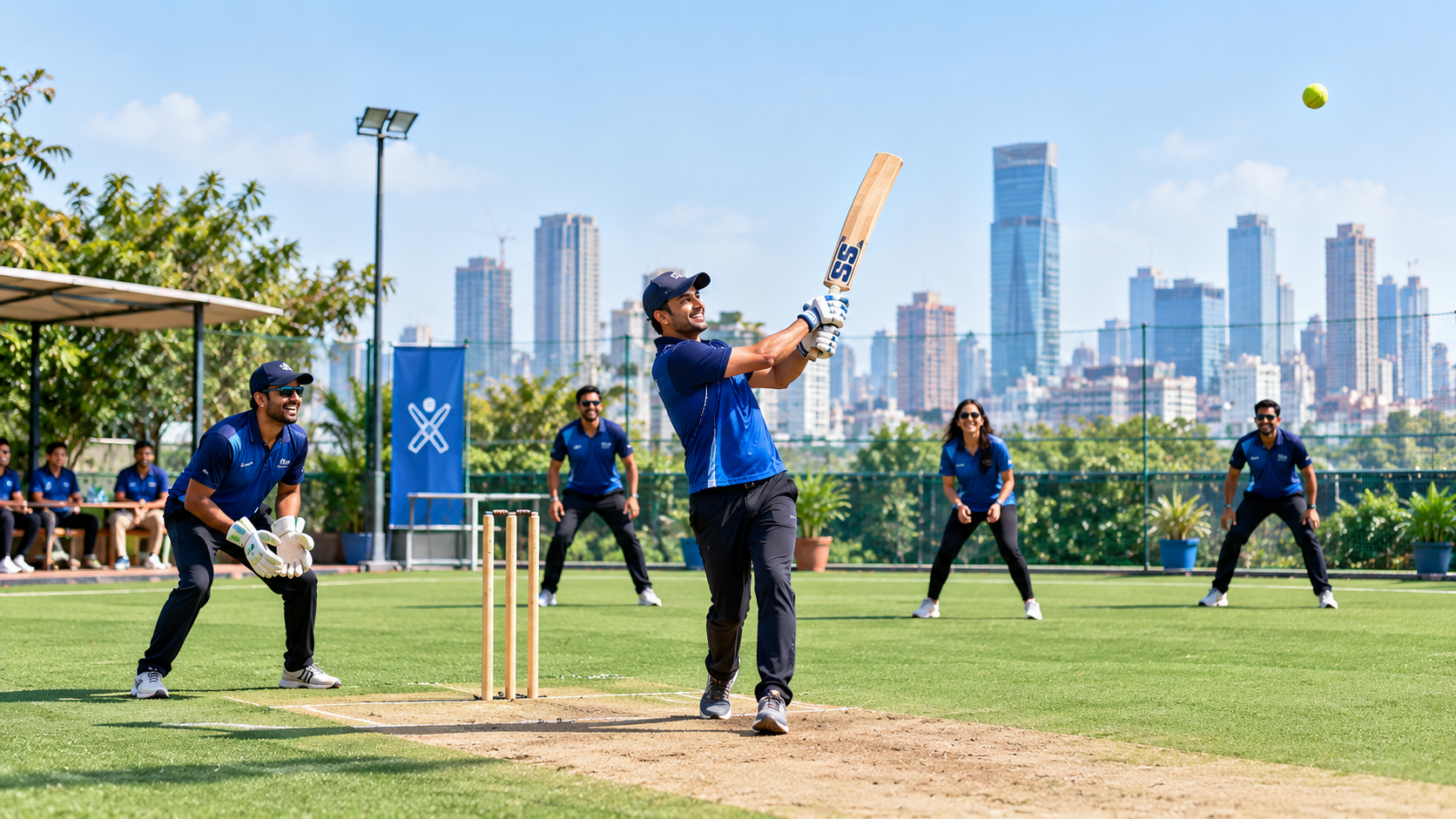
How to Organise a Corporate Cricket Tournament in Mumbai: Formats, Venues, Rules and a Timeline
Planning a corporate cricket tournament in Mumbai? Formats, venues, rules, safety, inclusion and a timeline HR can follow.
In Mumbai, cricket is the one activity almost every office already has an opinion about. That makes a corporate cricket tournament in Mumbai one of the easiest engagement events to get people excited about, and one of the easiest to get wrong. Matches overrun, teams are unevenly matched, half the office feels left out and someone pulls a hamstring because there was no warm-up. A little planning turns it from a chaotic Saturday into an event people talk about for months.
This guide covers the types of tournament, the formats, the venues, the rules, the safety basics, the inclusion questions and a timeline you can follow.
Why a Corporate Cricket Tournament Works
A tournament puts people from different teams on the same side, gives them a shared goal and creates stories that last. Research on team building, including a well-known meta-analysis in Small Group Research, found a positive effect on team outcomes, strongest for trust, cohesion and how teams work together. Mixed-department teams are one of the simplest ways to build those links.
It also moves people. The WHO’s guidelines on physical activity and sedentary behaviour recognise prolonged sitting as a health risk and recommend regular movement, which a sport day supports. The CII National Committee on Sports launched the Indian Corporate Cricket League in 2023, covering teams in Delhi NCR, Tamil Nadu, Karnataka and Maharashtra (Mumbai and Pune), with a stated aim of promoting health, fitness and physical activity among the corporate workforce. That shows how established the idea is.
Choose the Type of Corporate Cricket Tournament in Mumbai
An internal tournament. Teams drawn from departments or floors within your company. The simplest to run, with the most control over rules and inclusion.
An inter-company invitational. Your team plays teams from other companies. This needs a neutral venue, a clear schedule and agreed rules, and it adds networking value.
Joining an existing league. Corporate leagues exist in Mumbai, and past listings of local tournaments show formats such as eight teams playing T20 with league matches followed by knockouts. Check current editions, eligibility and fees directly with the organiser, since I can’t confirm what is running now.
A fun, social format. Tennis-ball or gully-style rules, mixed teams and relaxed scoring. Best for a first event or a mixed-ability group.
Pick the Format
Box cricket
Box cricket is played on a compact turf, and in urban centres like Mumbai it has grown popular because it fits small venues. According to one explainer, teams usually have 6 to 8 players, matches run 6 to 10 overs per side and a game typically lasts 30 to 60 minutes. It suits an internal tournament, because you can fit many matches into a day.
Ground cricket (T10 or T20)
Played on an open ground with a larger squad. It takes more space, more time and more planning, but suits a bigger, more serious event. The CII league’s first edition used T10 and T20 formats on weekends.
A simple tournament structure
For eight teams, a round-robin means 28 matches, which is too many for one weekend. A simpler plan is two groups of four. Each group plays 6 matches, giving 12 group matches, followed by 2 semi-finals and a final: 15 matches in total. At about 45 minutes per box cricket match with breaks, that is roughly a long day or a weekend. Adjust the over limit to fit your time.
Choose the Venue and Check Permissions
Box cricket turfs. Booked by the hour, usually with floodlights, and found across Mumbai. Book early for weekends and check cancellation terms.
Open grounds and maidans. Mumbai’s open grounds are popular and often need permission from the relevant club, association or authority. Ask early and do not assume a ground is free.
School, college or club grounds. May be available for a fee, often with better facilities.
Your own campus. Some larger campuses have enough space for a small ground or a box set-up, which saves travel.
When you choose, think about access. Mumbai teams travel from many parts of the city, so look for a venue reachable by train from your offices and with parking, toilets, drinking water, changing space, shade and a first-aid point. For evening matches, check floodlights.
Pick the Right Time of Year
October to February is the most comfortable window. In March to May, heat and humidity make midday play hard, so choose early mornings or floodlit evenings. In the monsoon from June to September, use covered or indoor turfs, or avoid outdoor fixtures. Avoid clashes with Diwali, Ganeshotsav and your own busy periods such as financial year-end. Weekends suit most teams, but think about employees with family commitments and offer a mix of morning and afternoon slots.
Set the Rules Before Anyone Registers
Agree these in writing and share them with all captains.
Who can play. Employees only, or contractors too? Decide your rule on former professional or state-level players, because a single ringer can ruin a friendly event.
Team size and mix. For example, 8 players per side including at least 2 women, or at least 1 person from a different department. Mixed rules make the event more inclusive and the teams more varied.
Bowling and batting limits. Cap overs per bowler, set a maximum for any one batter and require every player to bat or bowl.
Ball and equipment. Tennis ball or leather ball? Who provides gear? Helmets for any hard-ball format.
Tie-breaks. A super over, a bowl-out or a coin toss. State it beforehand.
Umpires and scoring. Appoint neutral umpires and a scorer, and say whose decisions are final.
Conduct. A short code covering respect, no abuse, no alcohol at the venue and sportsmanship. Include a Spirit of the Game award.
Weather and late arrivals. A rain plan and a rule on forfeits.
Make It Inclusive
Not everyone plays cricket, and not everyone wants to. Include them anyway.
Mixed teams and women’s matches. Set rules that give women meaningful roles, or run a separate women’s event.
Skill divisions. Offer a competitive and a social league, so beginners are not overwhelmed.
Non-playing roles. Scorers, commentators, photographers, a cheer squad, a hospitality team and organisers keep everyone involved.
Family and friends. An open invitation for families can turn the final into a celebration.
Hybrid employees. Share live updates, scores and photos so that remote staff feel part of it, and let them join non-playing roles.
Diet and culture. Offer food that suits vegetarian, Jain and allergy needs, and avoid alcohol.
Accessibility. Check the venue for people with limited mobility and give them roles that suit them.
Safety and Insurance
Cricket is a contact sport with real injury risk, so plan for it. Include a short warm-up before every session. Ask participants to self-declare any medical conditions, and make clear that no one is required to play. Provide first aid, water and shade, and arrange for a doctor or ambulance on call, especially for a larger event. Plan for heat and humidity with regular breaks. Use helmets and protective gear in any hard-ball format. Check that the ground is safe. And ask your insurer or broker whether your existing cover extends to employee sports events or whether you need accident cover for the day. Speak to your legal counsel about any waivers.
Plan the Budget
Typical costs include the venue, balls and equipment, umpires and a scorer, jerseys or bibs, trophies and awards, food and water, first aid, photography and insurance. Savings are available by using internal volunteers as scorers and organisers, branding simple bibs instead of full kits and combining the final with an existing celebration. Costs vary widely, so get itemised quotes. Spend where it improves the experience for the most people.
An Eight-Week Timeline
Weeks 8 to 7. Get leadership approval, set the budget, choose the type and format and appoint an organising team.
Weeks 6 to 5. Confirm the venue and permissions, draft the rules, set a date and open registration.
Week 4. Close registration, appoint captains, build the draw and schedule and book umpires, scorers and first aid.
Week 3. Send the schedule, rules and venue details to everyone, and confirm insurance.
Week 2. Hold a short captains’ briefing, confirm food and logistics, and order trophies and bibs.
Week 1. Check the weather outlook, confirm numbers and send reminders.
Match day. Arrive early, check the ground and first aid, brief teams, run the fixtures to time, and keep the energy positive.
After the event. Share photos and highlights, thank organisers and volunteers, announce awards, and gather feedback.
Make It More Than a Match
Give out Player of the Match, best team spirit and best fielder awards, so that recognition is not only for the highest scorers. Ask senior leaders to play or to be visibly present, which sends a message that this is for everyone. Share a post-match meal so people mix after the final whistle. Tell the story afterwards with photos and short write-ups. And if you add vouchers or privileges as prizes, choose ones people can use, such as dining or fitness offers.
How to Measure Success
Look at the registration rate, how many teams include people from different departments and how many first-time participants joined. Track repeat interest for the next edition. Ask for short feedback on the experience, fairness and organisation. Count injuries and near-misses. And check cost per participant. A good tournament builds momentum for a sports calendar, not a single day.
Common Mistakes
The most common mistake is too many matches for the time available. The second is unclear rules, which leads to arguments. The third is allowing professional ringers into a friendly event. The fourth is leaving out people who do not play. The fifth is skipping first aid and insurance checks. The sixth is ignoring the weather. The seventh is treating the event as a one-off, with no follow-up.
Getting Help Running Your Tournament
If your team lacks time, ICE’s Connect pillar is built around recurring on-ground engagement activities, and you can talk to ICE about adding a tournament to your calendar. Inform supports clear announcements and updates, and Reward offers dining, fitness and travel privileges that make useful prizes. For related reading, see how to make employee engagement activities work for everyone and why strong company culture starts with everyday experiences. To plan a corporate cricket tournament in Mumbai for your company, get in touch with ICE.
Follow ICE on LinkedIn, Instagram, Facebook, and YouTube for more HR and engagement resources.