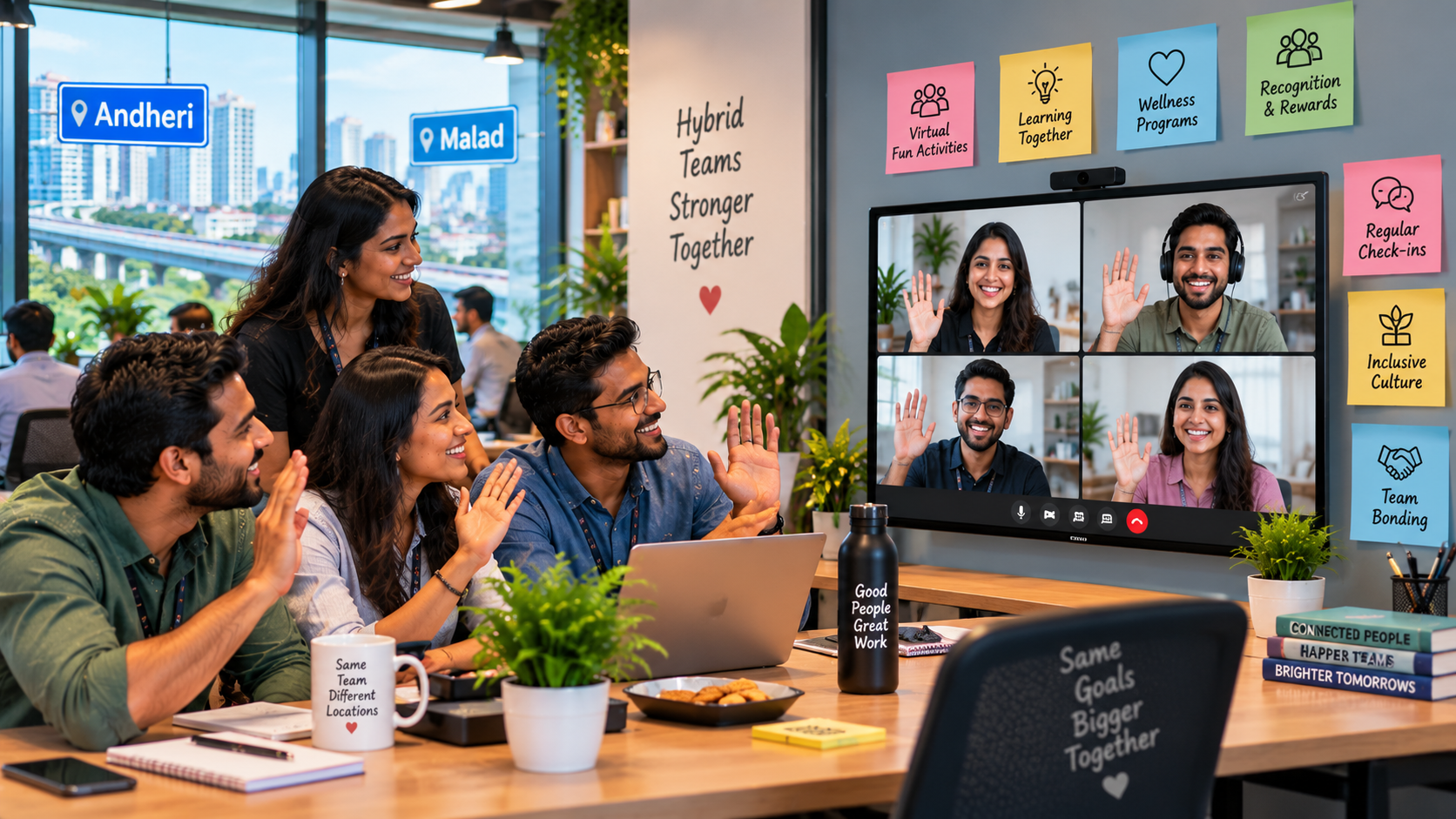
Employee Engagement Ideas for Hybrid Teams Working Out of Andheri and Malad
Managing a hybrid team in Andheri or Malad? Here are employee engagement ideas built for split in-office and remote schedules.
A hybrid team creates a specific engagement problem that a fully in-office or fully remote team doesn't face quite the same way: on any given day, part of the team is physically present and part isn't, and most engagement activities default to serving whoever happens to be in the room. Andheri and Malad, both dense with IT, media, and corporate offices running hybrid schedules, see this constantly. Interestingly, Gallup's ongoing workplace research has found that hybrid employees consistently report engagement levels that outpace both fully remote and fully on-site employees, when hybrid is actually managed well. The flexibility helps. But that advantage disappears fast if engagement efforts quietly exclude whoever's remote that day.
Why Hybrid Engagement Needs Deliberate Design
In a fully in-office team, spontaneous connection happens on its own. In a fully remote team, everyone's used to digital-first engagement by default. Hybrid sits awkwardly in between, spontaneous in-office moments happen, but only for people physically present, which means engagement design has to actively work against a two-tier experience forming, one for in-office days and a lesser one for remote days.
Engagement Ideas That Actually Work for Hybrid Andheri and Malad Teams
Anchor days built for connection, not just attendance, designating specific in-office days as genuinely engagement-focused, team activities, informal lunches, rather than just another day people happen to be at a desk, makes the commute feel worth it.
Hybrid-native activities, not in-office activities with a video call bolted on, formats like online trivia, virtual show-and-tell, or digital recognition platforms designed to work equally well for in-office and remote participants, rather than remote employees watching an in-person activity through a laptop camera.
Rotating facilitation so no one's schedule is always the exception, if the same people are consistently remote on activity days, engagement quietly becomes something that happens to other people; rotating activity days or offering flexible timing avoids a fixed group being perpetually left out.
Asynchronous recognition that doesn't depend on being in the room, recognition delivered through a channel everyone sees, in-office or not, rather than an in-person shoutout that remote team members simply miss.
Local, district-relevant activities for anchor days, given Andheri and Malad's density of cafes, parks, and informal venues, using the immediate neighbourhood for in-office day activities keeps logistics simple without needing to book distant venues.
Clear, predictable hybrid schedules, engagement planning works far better when teams have a stable, known pattern of who's in and when, rather than constantly shifting schedules that make consistent activity planning difficult.
Common Mistakes With Hybrid Engagement in Andheri and Malad Offices
The most frequent mistake is planning engagement activities purely around in-office days without adapting for remote participation, which quietly signals that engagement is really meant for whoever shows up physically.
The second mistake is over-relying on video calls as the default remote engagement format, when video fatigue is real and not every activity translates well to a screen; asynchronous and written formats deserve equal consideration.
The third mistake is not tracking engagement separately by attendance pattern, missing whether remote-heavy employees are quietly less engaged than their in-office-heavy colleagues, a gap that's easy to overlook without specifically looking for it.
How to Know If Hybrid Engagement Is Actually Working
Compare participation and feedback specifically between employees who are more often in-office versus more often remote, rather than looking only at an aggregate number that can mask a real gap between the two groups. Watch whether remote-heavy employees engage as readily with digital or asynchronous activities as in-office employees do with in-person ones.
Bringing Structure to Hybrid Engagement
ICE's Connect pillar is built to work across both in-office and hybrid formats, paired with Inform to keep communication consistent regardless of where someone's working from that day. For more, see how to make employee engagement activities work for everyone and where HR should start when engagement is low on the ICE blog.
Follow ICE on LinkedIn, Instagram, Facebook, and YouTube for more HR and engagement resources.