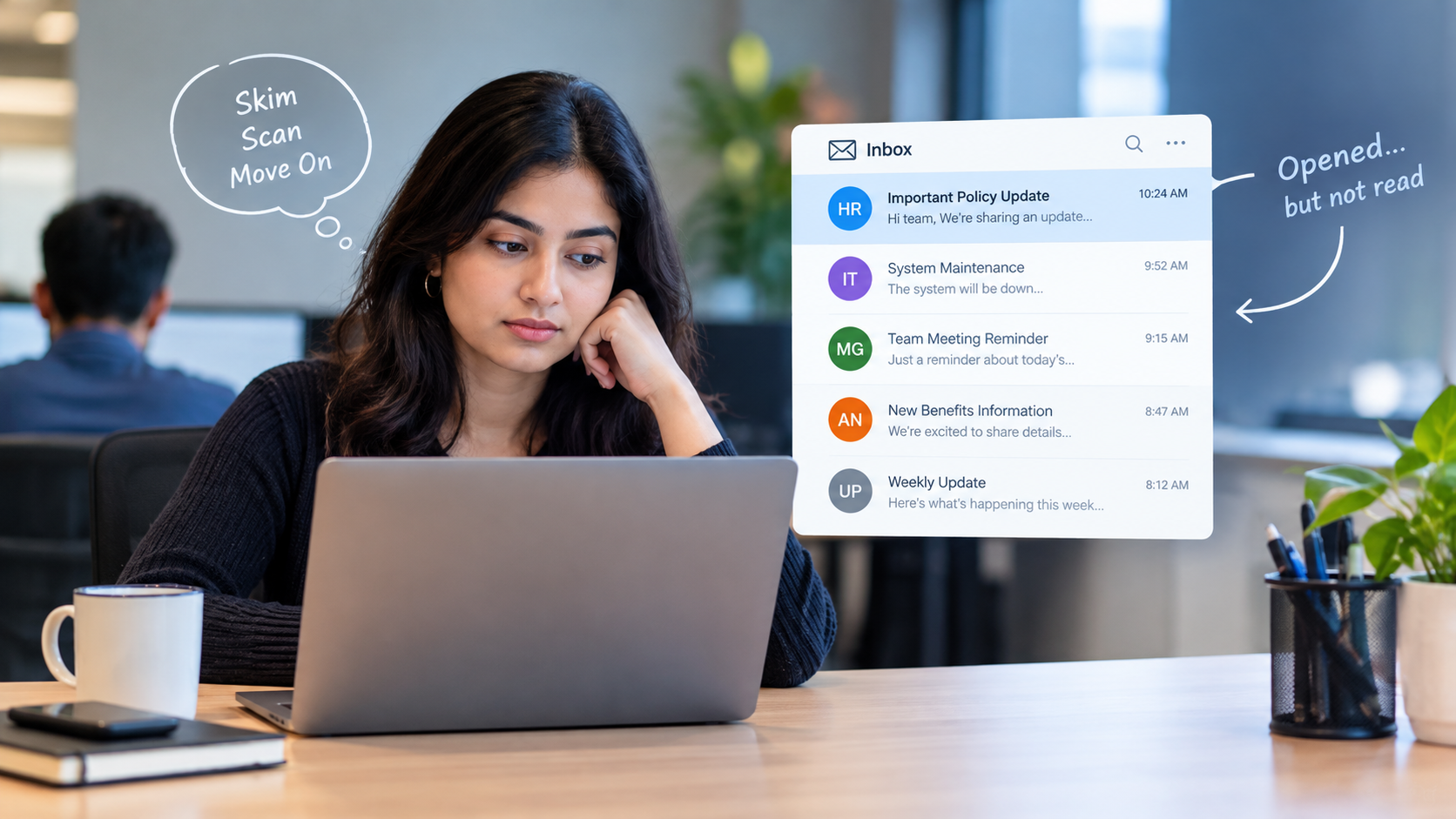
Why Employees Don't Read Company Emails (And What Works Instead)
Employees open your emails, most just don't absorb them. Here's why opening isn't reading, and what actually gets a message understood.
The common assumption is that employees ignore company email entirely, and it's not really true. Internal email open rates in recent industry benchmarking consistently run well above 60%, often into the 70s and 80s, genuinely higher than external marketing email. The actual problem is more specific, and more useful to understand: as one internal comms platform put it, open rate has become the base rate, not something particularly actionable on its own, since click-through and attention data give a far clearer picture of whether employees genuinely engaged with the content. Employees are opening the email. They're just not necessarily absorbing what's in it.
The Real Gap: Opening vs Understanding
An open is recorded the moment an email displays, often in a preview pane, without any guarantee anyone read past the first line. This gap, between technically opening something and genuinely absorbing it, explains a pattern most HR and comms teams recognise: a policy update goes out, open rates look fine, and two weeks later half the team still seems unaware of what changed. The email wasn't ignored. It was skimmed, and skimming doesn't transfer understanding the way a full, attentive read does.
Why Skimming Happens Even When Emails Get Opened
Volume competes for attention. An employee receiving a dozen internal emails a week develops a skimming habit almost by necessity, not out of disrespect for any single message, simply as a coping mechanism for inbox volume.
Dense, unstructured content resists skimming. A long block of text with the key point buried three paragraphs in gets skimmed past entirely, since skimming behaviour naturally looks for visual structure, headers, bold text, bullet points, to extract meaning quickly.
No clear "what does this mean for me" framing. Generic, broadly-addressed announcements require the reader to do the work of figuring out relevance to their specific role, work most skimming readers simply won't do.
Timing collides with low-attention moments. An email sent late in the day or right before a weekend, when attention is already depleted, gets a much shallower read than the same content sent at a genuinely attentive moment.
What Actually Improves Comprehension, Not Just Opens
Lead with the point, not the context. Structuring an email so the key takeaway is visible in the first line, not the conclusion after three paragraphs of background, respects how people actually read under time pressure.
Use structure deliberately. Headers, bolded key phrases, and short paragraphs aren't just formatting preferences, they're what makes a message skimmable in a way that still transfers the core meaning, rather than requiring a full, slow read to understand.
Personalise relevance where possible. Even a simple line naming which team or role a change affects most directly increases the odds a reader engages past the first sentence, since it answers "does this apply to me" immediately.
Pair email with a second, different-format touchpoint. A short follow-up in a team meeting, or a manager-led verbal summary, reinforces what email alone often can't fully land on its own, not because email failed, but because repetition across formats improves retention meaningfully.
Track engagement signals beyond open rate. Click-through rates, time spent, and whether follow-up questions from employees suggest genuine understanding are far more useful than a rising or falling open rate on its own.
Common Mistakes That Deepen the Skimming Problem
The most frequent mistake is writing internal emails the way a formal memo would be written, dense, comprehensive, front-loaded with context before the actual point, which is precisely the structure skimming behaviour skips past.
The second mistake is treating open rate as the primary success metric, celebrating a high open rate while the underlying comprehension problem, people opening but not absorbing, goes completely unaddressed.
The third mistake is sending everything through the same channel regardless of importance, so a routine update and a genuinely significant policy change look identical in the inbox, with nothing signalling which one actually needs a slower, more careful read.
Building Communication That Gets Understood, Not Just Opened
ICE's Inform pillar covers policy and leadership communication built around genuine comprehension, not just delivery. For more, see how HR can improve communication with employees and why internal communication is the foundation of employee engagement on the ICE blog.
Follow ICE on LinkedIn, Instagram, Facebook, and YouTube for more HR and communication resources.