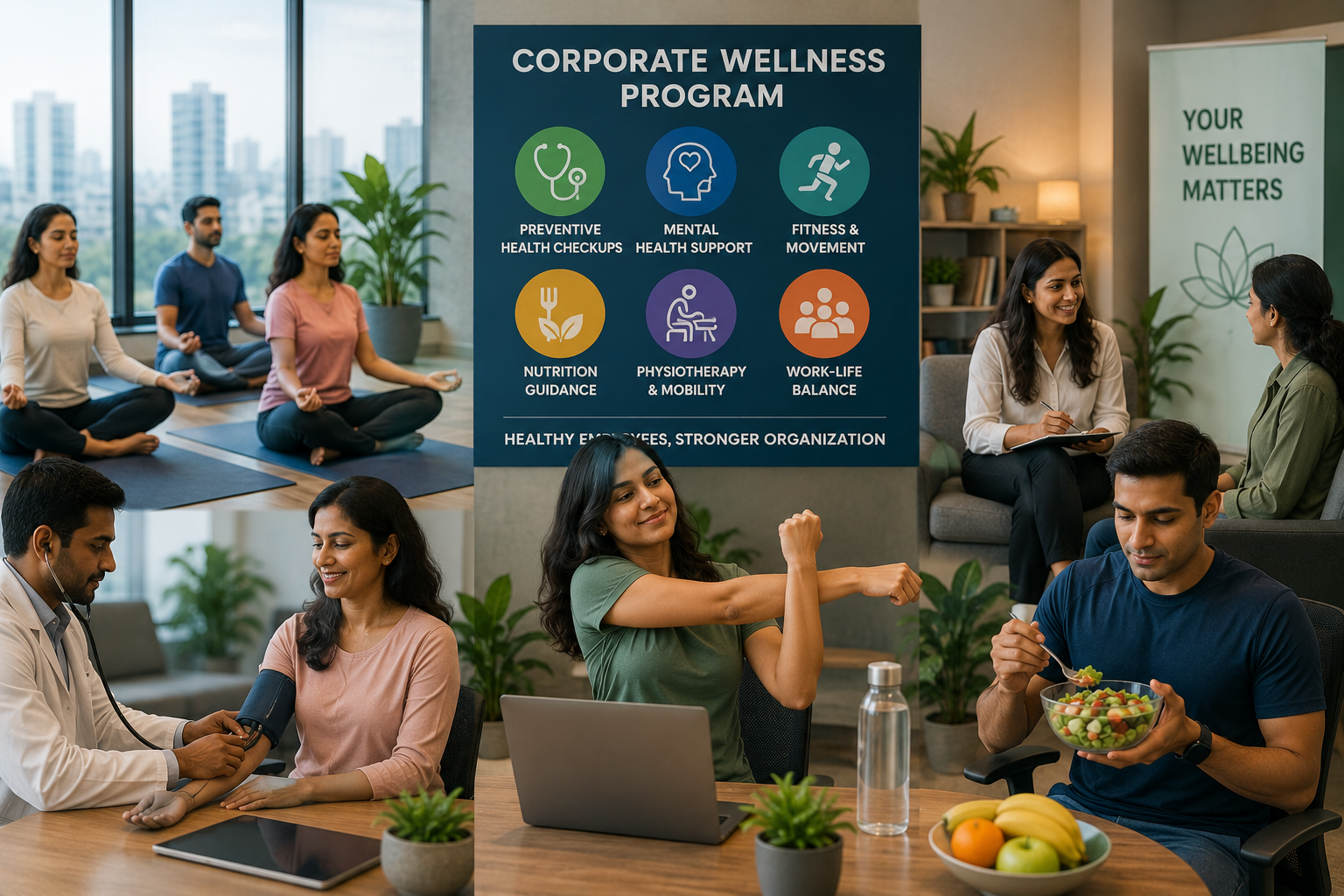
What Should a Corporate Wellness Program in Mumbai Actually Include?
"Can you also add a wellness component" is a line many HR managers have heard from leadership, usually without much detail on what that should actually contain. So it becomes a yoga session booked for a Friday afternoon, attendance is thin, and the box gets marked as done for the year.
That's not a wellness program. It's a single activity mistaken for one. A real corporate wellness program in Mumbai needs to account for long commutes, sedentary desk jobs, high-pressure sectors like BFSI and IT, and a workforce that increasingly expects mental health support to be part of the package, not an afterthought.
What Is a Corporate Wellness Program?
A corporate wellness program is a structured set of initiatives an organisation offers to support employees' physical, mental, and sometimes financial wellbeing, delivered on an ongoing basis rather than as a single event. It typically includes some mix of health screenings, fitness sessions, mental health support, nutrition guidance, and preventive care.
Why Wellness Directly Affects Engagement, Not Just Health
Wellness and engagement are often budgeted separately, as if one is a health initiative and the other is a culture initiative. In practice, they overlap heavily. Employees dealing with unmanaged stress, poor sleep, or untreated health issues are far less likely to show up fully for team activities or day-to-day collaboration.
The World Health Organization's guidance on mental health at work notes that psychosocial risks tied to job content, workload, and workplace conditions can meaningfully affect employees' mental health, which makes wellness less of a perk and more of a foundational condition for engagement to even be possible.
What Should a Corporate Wellness Program in Mumbai Include?
Preventive health screening, not just annual checkups
A single annual health checkup catches very little. Programs that include periodic diagnostic screening, dental checkups, eye care, and specialist consultations catch issues earlier.
Mental health support that is actually accessible
This means confidential access to psychologists or counsellors, not just a poster with a helpline number. This is one of the most commonly missing pieces in otherwise well-funded programs.
Fitness and movement built around desk-heavy days
Zumba sessions, yoga, and mindfulness breaks work best when scheduled during the workday rather than expected to happen after a long commute home.
Nutrition guidance, not just healthy snacks in the pantry
Sessions with dietitians that offer personalised, practical guidance tend to have more lasting impact than a one-time poster campaign.
Physiotherapy and mobility support
For a largely desk-bound, screen-heavy workforce, physiotherapy access addresses a very real and common source of discomfort.
Common Gaps in Wellness Programs
The most common gap is treating wellness as a single event rather than a recurring calendar.
The second gap is ignoring mental health almost entirely, often because it feels harder to measure or more sensitive to introduce.
The third gap is designing the program without asking employees what they actually want.
What This Looks Like in Practice
Consider two versions of the same brief: "add a wellness component." Version one is a single yoga session booked once a quarter, announced by email, with no follow-up. Attendance is inconsistent, and by the second quarter it quietly disappears from the calendar.
Version two starts with a short internal survey asking employees what they'd actually use. It's scheduled around actual work hours, communicated consistently, and reviewed every quarter against simple participation data. Neither version costs dramatically more than the other; the difference is design, not budget.
How Do You Know If a Wellness Program Is Actually Working?
Look past attendance at individual sessions and check whether participation holds up across the year rather than dropping off after the first quarter. Track whether employees are using services that require them to opt in repeatedly, like ongoing counselling or fitness memberships, since sustained voluntary use is a much stronger signal than one-time turnout.
When to Bring in a Wellness Partner
External wellness partners typically make sense when HR lacks the medical and clinical relationships needed to run screenings, mental health sessions, and specialist consultations credibly and confidentially.
ICE's Health & Wellness offering is built around 18 ready-to-deploy services spanning preventive screening, mental health sessions with psychologists, physiotherapy, and specialist consultations. For a broader look, ICE's blog has a related piece on what a corporate wellness program should actually include and one on how to choose corporate wellness services for your workforce. If you're weighing whether wellness spend actually pays off, this is also covered in how corporate health and wellness programs support employee productivity.
A Quick Evaluation Checklist
- Does the program include more than one physical health touchpoint a year?
- Is mental health support genuinely confidential and accessible?
- Are sessions scheduled with commute and desk-hour fatigue in mind?
- Is delivery flexible enough to reach employees across multiple locations or hybrid setups?
- Has the program been shaped by what employees say they need?
Follow ICE on LinkedIn, Instagram, Facebook, and YouTube for more HR and wellness resources.