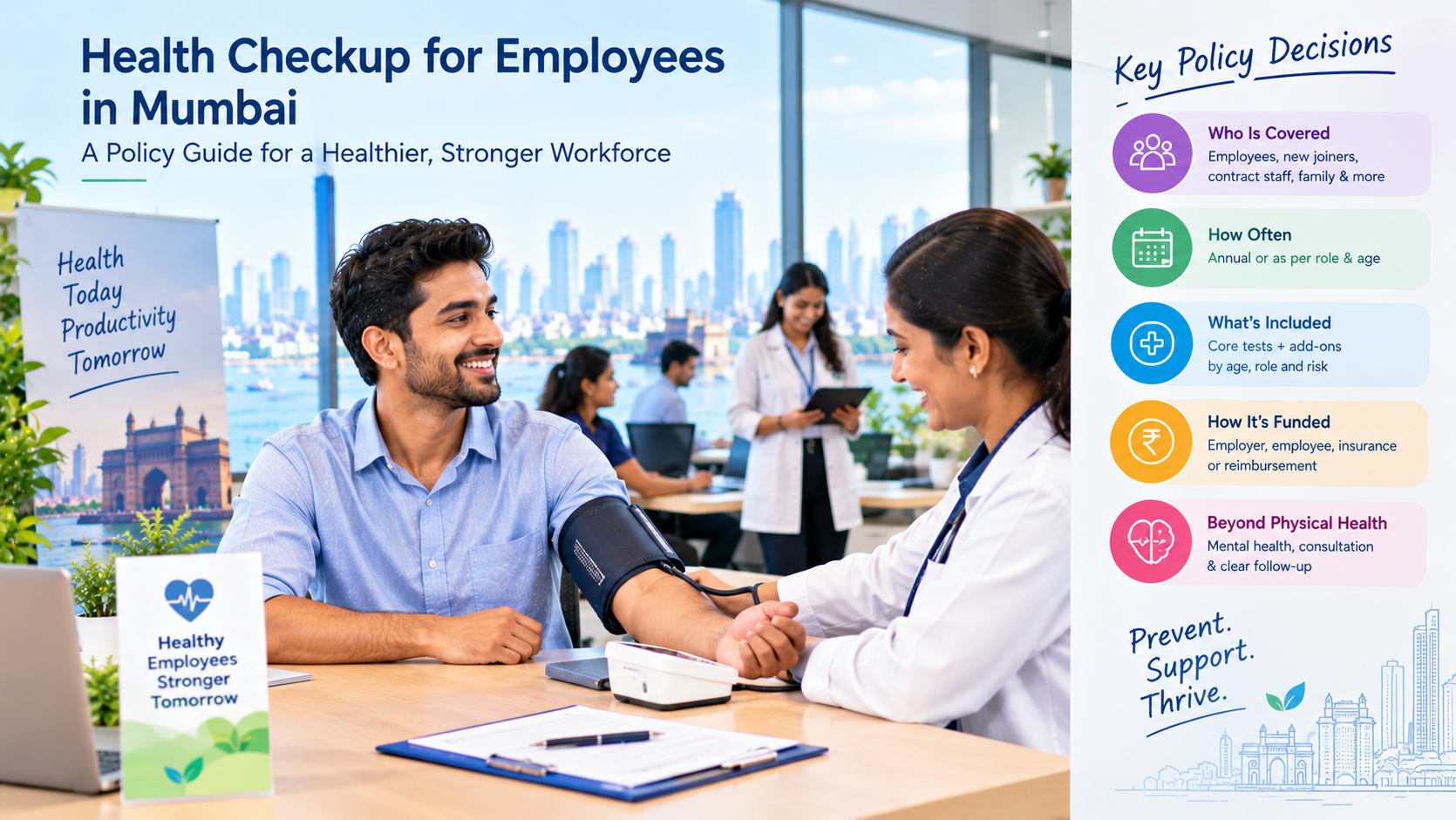
Health Checkup for Employees in Mumbai: How to Design a Policy People Will Actually Use
Many companies offer a health checkup for employees in Mumbai without ever writing down the rules. Who is eligible? How often? Which tests? Who pays? What happens if something turns up? Without answers, the benefit gets used unevenly: confident, health-conscious people book it, while the people who most need it never do. A clear policy fixes that, and it costs very little to write.
This guide walks through the decisions a good policy covers, with the Mumbai-specific details that make the difference between a checkup people use and one that sits in the handbook.
Why You Need a Policy, Not Just a Camp or a Package
A one-day camp or a vendor package solves a delivery problem. A policy solves a fairness and follow-through problem. It sets out who is covered, how often, what is included, how results are handled and what support follows. It also lets employees plan, since they know what they are entitled to every year.
The case for prevention is strong. A CII-MediBuddy workplace health report, covered by The Tribune, argued that Indian companies need to shift towards preventive workplace healthcare. A written checkup policy is one of the simplest ways to put that into practice.
Decision 1: Who Is Covered
All permanent employees. Most companies start here, so everyone is treated the same way.
Probation and new joiners. Decide whether eligibility starts on day one or after a set period. Many companies include new joiners to signal care early.
Contract, consultant and support staff. Security, housekeeping and contract workers often keep the office running and are often left out. Decide deliberately, not by default.
Family members. Extending a discounted rate or a covered checkup to spouses and parents is valued highly, and can be offered at employee cost.
Frontline and shift staff. Make sure the policy works for people who cannot leave their post at midday.
Decision 2: How Often
Annual is the standard, and a good default for adults. Some companies move to every two years for younger employees with a lighter annual screen in between, and keep annual checks for older staff or those with higher-risk roles. Whatever you choose, state it clearly, and make sure the doctors involved agree.
Decision 3: What Is Included
A health checkup for employees in Mumbai usually works best as a core package for everyone, with additions by age and role. The exact tests should be set with qualified doctors, not by HR alone. The tiers below are a common structure, not medical advice.
The core package
A physical examination, blood pressure, height, weight and BMI, blood sugar, a lipid profile, haemoglobin and a basic urine test. Many packages also include a vision check.
Additions by age and risk
Providers commonly add tests such as an ECG, HbA1c, thyroid, liver and kidney function, vitamin levels and cardiac risk assessments as people get older or if family history suggests higher risk. Women’s health screening is usually offered as an optional, private add-on.
Additions by role
Desk-based employees often benefit from eye checks and a posture assessment, since the WHO’s guidelines on physical activity and sedentary behaviour recognise prolonged sitting as a health risk. Shift workers may need extra attention to blood pressure, blood sugar and sleep. Drivers and field staff may need vision and hearing checks. Ask the provider how each package is built.
A mental health touchpoint
A confidential conversation with a counsellor or a clear route to one is valuable. NIMHANS survey data reported by the government found mental disorder prevalence was nearly twice as high in urban metro regions as in rural areas, which makes this a sensible part of any Mumbai checkup.
A doctor’s consultation and a written summary
A checkup without an explanation is half a service. Include a short consultation or a clear, plain-language report.
Decision 4: How It Is Funded
There are several models, and many companies combine them.
Employer-paid for everyone. The simplest and most equitable approach.
Employer-paid core package, employee-paid extras. The company covers a standard checkup, and employees can add tests at a corporate rate.
Insurance-linked. Some group health insurance policies include preventive checkups or outpatient cover. Check what yours actually offers, since many employees do not know.
Reimbursement. Employees book their own checkup and claim up to a limit. This suits remote and hybrid staff but needs clear rules and receipts.
Family at employee cost. The company negotiates a discounted rate for family members.
Ask your chartered accountant how employer-paid checkups are treated for tax, and have finance track the cost per employee.
Decision 5: How It Is Delivered
On-site. A visiting team sets up for a day. This has the highest participation, because employees do not travel. See the guide to planning a corporate health camp for the logistics.
Partner diagnostic centres. Employees book a slot at a centre near the office or home. This suits small teams and distributed staff, but participation tends to be lower because it takes time.
Home sample collection. Useful for remote staff and for people who prefer privacy, although some tests still need a visit.
Mumbai adds practical points. Long commutes mean a centre far from home will be skipped, so choose providers near where people live and work. Some tests need fasting, so schedule early-morning slots. Shift staff need slots outside standard hours. And monsoon travel disruption means flexible rebooking should be part of the arrangement.
Decision 6: Privacy and Consent
Health data is sensitive, and employees will only take part if they trust it will be protected. The government notified the DPDP Rules in November 2025 with an 18-month phased timeline, including clear consent notices. Ask your legal counsel which obligations apply to you and when.
A sensible policy states that participation is voluntary, that individual results go only to the employee, that the company receives anonymised group trends only and that results will never be used in performance, promotion or hiring decisions. Say this in plain language, and repeat it.
Decision 7: Follow-Up
This is where most policies fail. A checkup flags risks. It does not diagnose, and it does not treat. Build follow-up into the policy:
A clear referral route. Employees with an abnormal result should know whom to see and how.
Time to attend. Allow paid time for follow-up appointments, so people do not have to choose between their health and their leave.
Linked support. Connect results to services such as counselling, physiotherapy and nutrition guidance.
A second reminder. A gentle, private reminder a few weeks later, with no pressure, improves follow-through.
Tracking. Count how many people complete follow-up, not just how many attended.
Keep It Voluntary and Fair
Do not make the checkup compulsory unless a law requires it for a specific role. Encourage, do not pressure. Make sure managers support employees in taking time for it. Avoid any suggestion that declining affects a person’s standing.
Communicate It Properly
Announce the policy clearly: who is covered, how often, how to book, what to bring, whether to fast and what happens with results. Repeat the message at onboarding and at the start of each cycle. A benefits report found 73% of employees want more education on the benefits they already have, so awareness is half the battle.
How to Measure It
Track the share of eligible employees who take the checkup, how that varies by team, location and shift, how many complete follow-up and how many return the following year. Collect short feedback on the experience. Over time, look at anonymised health trends, and sick-leave patterns, in aggregate only.
Common Mistakes
The most common mistake is offering a checkup with no follow-up. The second is a policy that excludes contract and frontline staff. The third is choosing a provider far from where people work. The fourth is unclear privacy, so people stay away. The fifth is making it feel compulsory. The sixth is never communicating the policy again after the launch.
Getting Support
If you want help designing and delivering the programme, ICE’s Health & Wellness offering brings together 18 ready-to-deploy services, including preventive screening, specialist consultations, physiotherapy and psychologist-led sessions, so a checkup can link directly to ongoing support. Inform helps with clear, repeated communication. For more reading, see what a corporate wellness program should actually include and how corporate health and wellness programs support employee productivity. To plan a health checkup for employees in Mumbai for your team, contact ICE.
Follow ICE on LinkedIn, Instagram, Facebook, and YouTube for more HR and wellness resources.