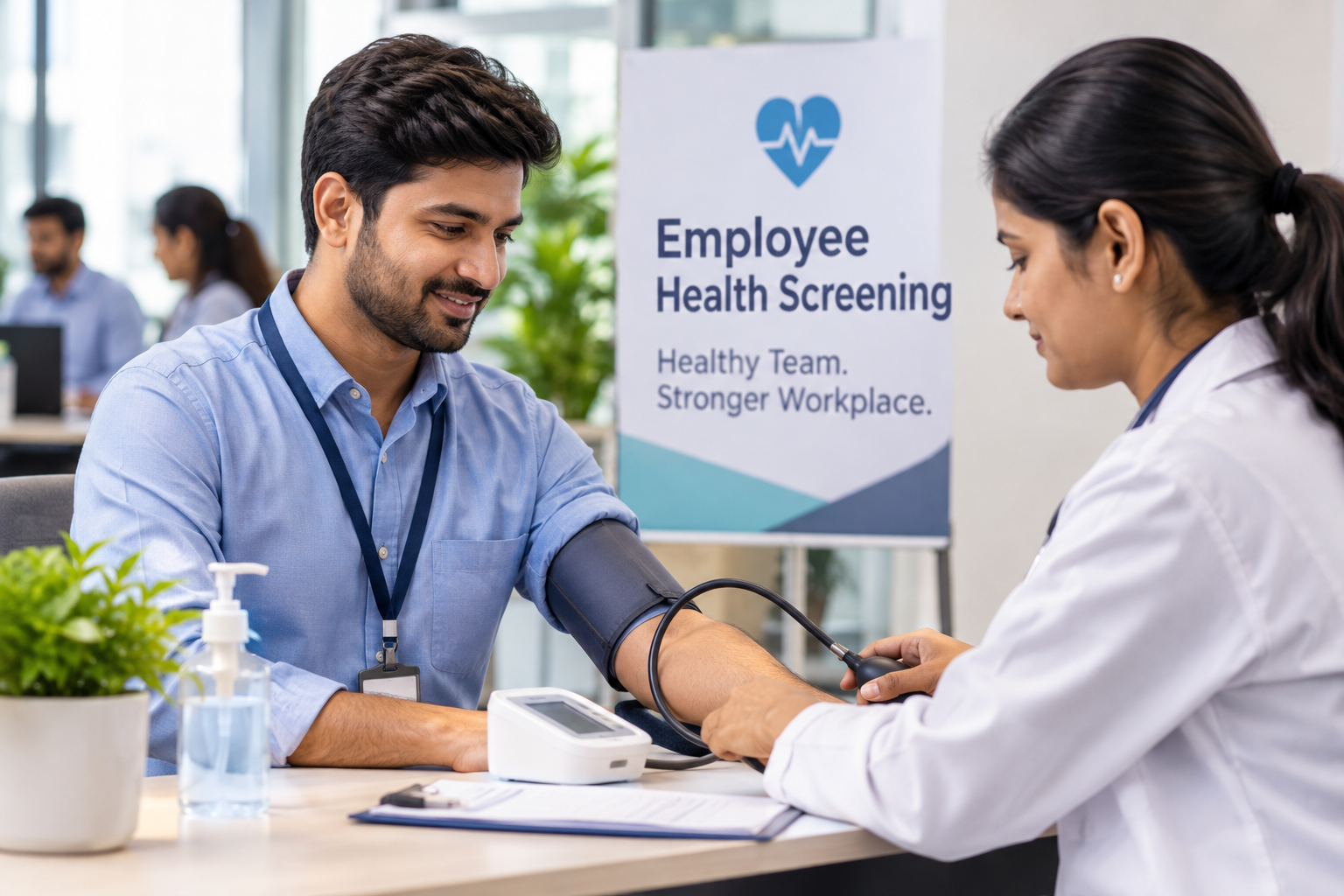
Employee Health Screening in Mumbai: Which Tests Are Worth Offering and How to Make Follow-Up Happen
Employee health screening in Mumbai: which tests are worth offering, why targeted beats full-body packages and how to make follow-up happen.
Many companies think of employee health screening in Mumbai as a package: a long list of tests, a vendor, a day in the office. The longer the list, the better it seems. The research suggests something more careful. A well-designed screening programme is targeted, linked to follow-up and honest about what screening can and cannot do. An over-sold one can create anxiety, extra tests and little benefit.
This guide explains what screening is, what the evidence says, which tests are worth considering, how to build in follow-up and how to protect privacy. It is general information, not medical advice, and your programme should be set with qualified doctors. For the policy side of annual checkups, see our guide to a health checkup for employees in Mumbai.
What Screening Is and What It Is Not
Screening looks for early signs of a condition in people who have no symptoms. It flags risk. It does not diagnose, and it does not treat. Someone with an abnormal result needs a doctor’s review. Someone with a normal result is not guaranteed to be healthy, and people with symptoms should not wait for a screening day.
What the Evidence Says About General Health Checks
A Cochrane systematic review of randomised trials found that general health checks in adults had little or no effect on total mortality or cancer mortality, and the authors concluded they are unlikely to be beneficial. An earlier version published in the BMJ also found that health checks increased the number of new diagnoses without reducing morbidity or mortality, while noting that some trials found effects on measures such as blood pressure and cholesterol.
This does not mean screening is pointless. Those trials looked at general, wide-ranging checks in populations not selected for risk, mostly outside India. It means that sweeping, one-size-fits-all packages are not well supported, and that targeted screening for specific conditions, linked to follow-up, is a more defensible approach. Ask your doctors to set the protocol, rather than letting a vendor’s package decide.
Why Targeted Screening Makes Sense in India
India carries a heavy burden of metabolic conditions. The ICMR-INDIAB national study, published in The Lancet Diabetes & Endocrinology, estimated that in 2021 India had about 101 million people with diabetes, 136 million with prediabetes and 315 million with hypertension. Many people with these conditions do not know they have them, and they are often silent in the early stages. That makes simple, repeatable checks for blood pressure, blood sugar and cholesterol a practical focus for a workplace programme.
Employee Health Screening in Mumbai: What to Consider Offering
The exact list should be set by your doctors, according to age, sex, risk factors and role. The following is a common, targeted structure.
Core checks for most adults
Blood pressure. Quick, cheap and useful, since hypertension is common and often silent.
Blood glucose or HbA1c. To identify diabetes and prediabetes.
Lipid profile. To assess cholesterol and cardiovascular risk.
Height, weight, BMI and waist measurement. A simple view of weight-related risk.
Vision check. Particularly useful for screen-heavy roles.
Role-related checks
Desk-based staff. Posture and musculoskeletal assessment, and eye-strain advice.
Night and rotating shift staff. Attention to blood pressure, blood sugar and sleep patterns.
Drivers, technicians and field staff. Vision and hearing checks as relevant to the job.
Staff in noisy or hazardous settings. Occupational checks set by your safety and medical advisers.
Mental wellbeing
A short, validated questionnaire administered and interpreted by a qualified professional, with a clear and confidential route to a counsellor, can help identify people who would benefit from support. It must be voluntary, private and linked to real help. NIMHANS survey data reported by the government found mental disorder prevalence was nearly twice as high in urban metro regions as in rural areas, which makes a trusted route to support valuable in Mumbai.
Age- and risk-based additions
Doctors may add tests depending on age, sex and family history. Women’s health screening should be optional, private and led by suitably qualified doctors. Ask whether imaging or broad panels, such as tumour markers, are appropriate for people without symptoms or risk factors, since broad panels can produce false alarms and unnecessary follow-up tests.
What to Be Cautious About
Be wary of packages sold on the number of tests, “full-body” scans for people without symptoms and anything that promises to catch everything. Ask the provider to justify each test: what condition it looks for, in whom and what happens after an abnormal result. A shorter list with a clear pathway is better than a long list with none.
Build the Follow-Up Pathway First
A screening result with no next step is half a service. Design the pathway before you book the camp.
Explain results in plain language. A doctor or nurse should explain each person’s results privately.
Use a simple triage. For example: results that need urgent medical attention, results that need a doctor’s review within a few weeks and results that need lifestyle support. Your doctors should define the categories.
Provide a referral route. Employees should know whom to see and how to book, and ideally have access to specialist consultations without a long wait.
Give paid time to attend. People should not have to choose between their health and their leave.
Link to support. Counselling, physiotherapy, nutrition guidance and movement programmes for people who need them.
Send a gentle, private reminder a few weeks later.
Track completion. Count how many people complete follow-up, not just how many were screened.
Privacy and Consent
Health data is sensitive, and people will take part only if they trust it will be handled properly. The government notified the DPDP Rules in November 2025 with an 18-month phased timeline, including clear consent notices, so ask your legal counsel which obligations apply.
As a practical rule, make participation voluntary, explain in plain language what is collected and why, give individual results only to the employee, share only anonymised group trends with the company and state that results will never be used in performance, promotion or hiring decisions.
Delivering Screening in Mumbai
On-site. The highest participation, because nobody travels. Check building rules, vendor passes, private rooms, power and hygiene. See our guide to a corporate health camp in Mumbai.
Partner centres. Suitable for small teams and distributed staff, though participation tends to be lower.
Home sample collection. Useful for remote staff, though some tests need a visit.
Timing. Some blood tests need fasting, so schedule early mornings. Offer extra slots for shift staff. Avoid month-end and deadline weeks.
Hybrid and remote staff. Offer vouchers for a nearby centre or a virtual consultation.
Monsoon. Have a backup date and flexible rebooking.
Questions to Ask a Provider
Who sets the protocol, and what are the doctors’ qualifications? Why is each test included, and for whom? Which laboratory processes the samples, and is it accredited? How are results explained and delivered privately? What is the follow-up pathway? How is biomedical waste handled? What data do you collect, store and share? How will you report to us, and in what form? Can you scale the programme by age and role? What is not included in the price?
How to Measure Success
Track the share of eligible employees screened, by team, location and shift. Track completion of follow-up consultations. Look at repeat participation the next year. Collect short feedback on the experience. Over time, review anonymised group trends, such as the share of employees with raised blood pressure or blood sugar, to see whether your programme and support are making a difference. Be careful with small groups, so that no individual can be identified.
Common Mistakes
The most common mistake is buying a long package with no follow-up. The second is choosing tests by the vendor’s list, not by a doctor’s protocol. The third is weak privacy, so people stay away. The fourth is ignoring shift and remote staff. The fifth is treating a normal result as a guarantee of health. The sixth is one screening a year with no support between. The seventh is making it feel compulsory.
Where ICE Fits
ICE’s Health & Wellness offering brings together 18 ready-to-deploy services, including preventive screening, specialist consultations, physiotherapy and psychologist-led sessions, so screening can connect to ongoing support. Inform helps with clear, repeated communication about the programme. For related reading, see what a corporate wellness program should actually include. To plan employee health screening in Mumbai for your team, contact ICE.
Follow ICE on LinkedIn, Instagram, Facebook, and YouTube for more HR and wellness resources.