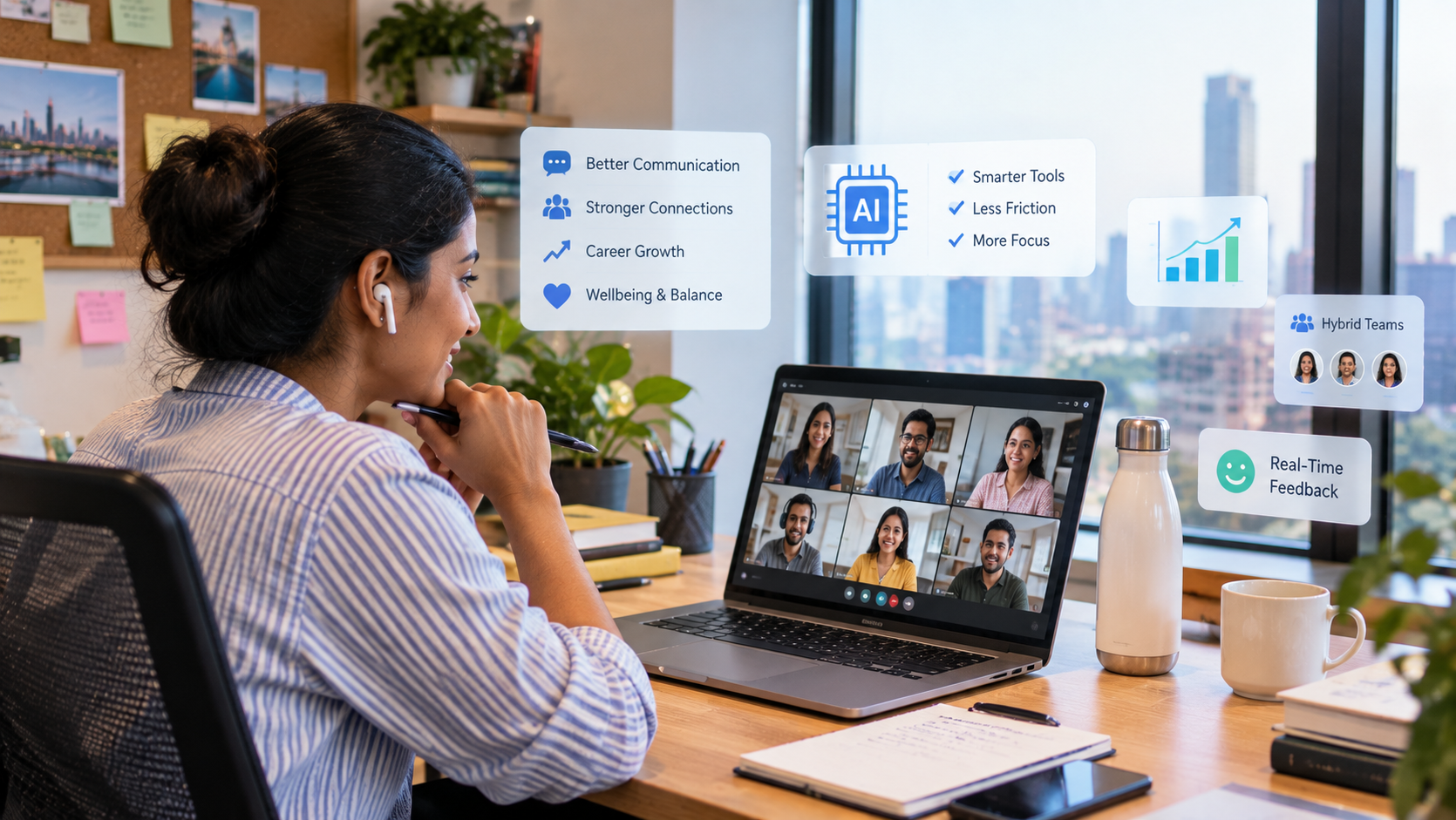
What Counts as Employee Engagement for a Digital Workforce in 2026?
What actually counts as employee engagement for a digital workforce in 2026? Here's what's changed, and what HR should be measuring now.
The definition hasn't changed as much as the terrain underneath it has. Employee engagement still means how invested, motivated and connected someone feels toward their work. What's shifted is where that feeling actually gets built or broken, increasingly inside digital tools, AI-mediated workflows and distributed teams rather than a shared physical office. Gallup's most recent tracking found engagement in the U.S. sitting at just 31% in the first half of 2026, unchanged from 2025, with younger workers, hybrid workers and managers showing the sharpest declines since 2020, the exact groups most exposed to this shift. Knowing what counts as engagement now means knowing where to actually look.
Why the Old Engagement Checklist Is Incomplete
Free snacks, an annual survey and a town hall used to cover most of what "engagement" meant. None of those address what's actually driving disengagement in a digital-first workforce: friction in the tools people use all day, uncertainty about how AI is changing their role, and managers stretched thin trying to hold distributed teams together. Gallup's data shows engagement has lost roughly 8 million engaged employees in the U.S. since 2020, at an estimated cost of $2 trillion a year in lost productivity. That's not a snacks-and-town-hall problem.
What Actually Counts as Engagement for a Digital Workforce
Digital tool experience, not just access to tools. Friction inside everyday software, slow systems, disconnected platforms, tools that don't talk to each other, has a measurable effect on motivation and productivity, especially in hybrid settings where a bad digital experience can't be offset by walking over to ask someone for help.
Transparency and trust around AI. How a company communicates AI-driven change, what's automating, what isn't, what it means for roles, is now a genuine engagement factor. Employees navigating uncertainty about their own role's future disengage quickly without honest, direct communication about it.
Manager enablement, specifically. Gallup's own tracking shows manager engagement has fallen even faster than the overall figure. Managers holding together distributed, digitally-mediated teams need real support and training, not just a dashboard and a target.
Continuous listening over annual surveys. A once-a-year engagement survey can't keep pace with how quickly sentiment shifts in a fast-moving digital workplace. Organisations tracking engagement continuously, through pulse checks and passive signals, respond to problems while they're still small.
Personalised, embedded growth and recognition. Generic annual training and once-a-year awards increasingly underperform. Research has found meaningfully higher engagement uplift where reskilling is structured and relevant, and recognition delivered continuously within the flow of work rather than saved for a ceremony.
A single, coherent digital hub. Employees relying on a scattered mix of apps and platforms to get basic information experience that fragmentation as friction. Consolidating toward one clear digital workplace hub is increasingly treated as an engagement lever in its own right, not just an IT decision.
Structural wellbeing, not just a wellness perk. Burnout in 2026 is being tracked as financial and social as well as physical, workload design and realistic expectations now sit inside the engagement conversation, not as a separate HR initiative.
Where This Leaves HR
None of this replaces the fundamentals, communication, recognition, connection, trust, still matter exactly as much as they always did. What's changed is that a meaningful share of where those fundamentals actually get delivered or dropped has moved into digital, AI-touched, and distributed spaces that a traditional engagement calendar was never built to reach.
Common Mistakes Companies Make Right Now
The most frequent mistake is treating AI adoption purely as an IT or productivity rollout, with no attention to how uncertainty about it affects engagement. The second is continuing to rely on an annual survey as the primary engagement signal, when sentiment in a fast-changing digital workplace shifts far faster than an annual cycle can catch. The third is investing in engagement platforms and dashboards without addressing the underlying manager burnout that's driving a large share of the decline.
Building Engagement for How Work Actually Happens Now
ICE's Inform and Connect pillars are built to work across in-office, hybrid and digitally-mediated teams rather than assuming a single physical location. For more, see how to measure employee engagement without sending another survey on the ICE blog.
Follow ICE on LinkedIn, Instagram, Facebook, and YouTube for more HR and engagement resources.