How Digital Communication Can Be One of the Strongest Tools for Mass Employee Engagement
Why digital communication is one of the strongest tools for mass employee engagement, and where it still needs a human hand alongside it.
Engaging fifty people in one office is a scheduling problem. Engaging five thousand people across ten locations, three shifts and a mix of desk-based and frontline roles is a completely different category of problem, one that in-person effort alone genuinely cannot solve. This is where digital communication earns its place as one of the strongest tools available for mass employee engagement: it is the only mechanism that can reach everyone, consistently, at roughly the same cost whether the audience is fifty people or five thousand.
What "Mass" Engagement Actually Requires
Engaging a large, distributed workforce well requires three things that don't scale naturally through in-person effort alone: a consistent message reaching everyone at the same time, a way to hear back from people at scale rather than just broadcast to them, and a cost per person that doesn't rise in a straight line with headcount. Digital channels are built for exactly this, which is why they outperform in-person-only strategies the moment an organisation grows past a size where everyone can genuinely be reached face to face.
Why Digital Communication Reaches People Nothing Else Can
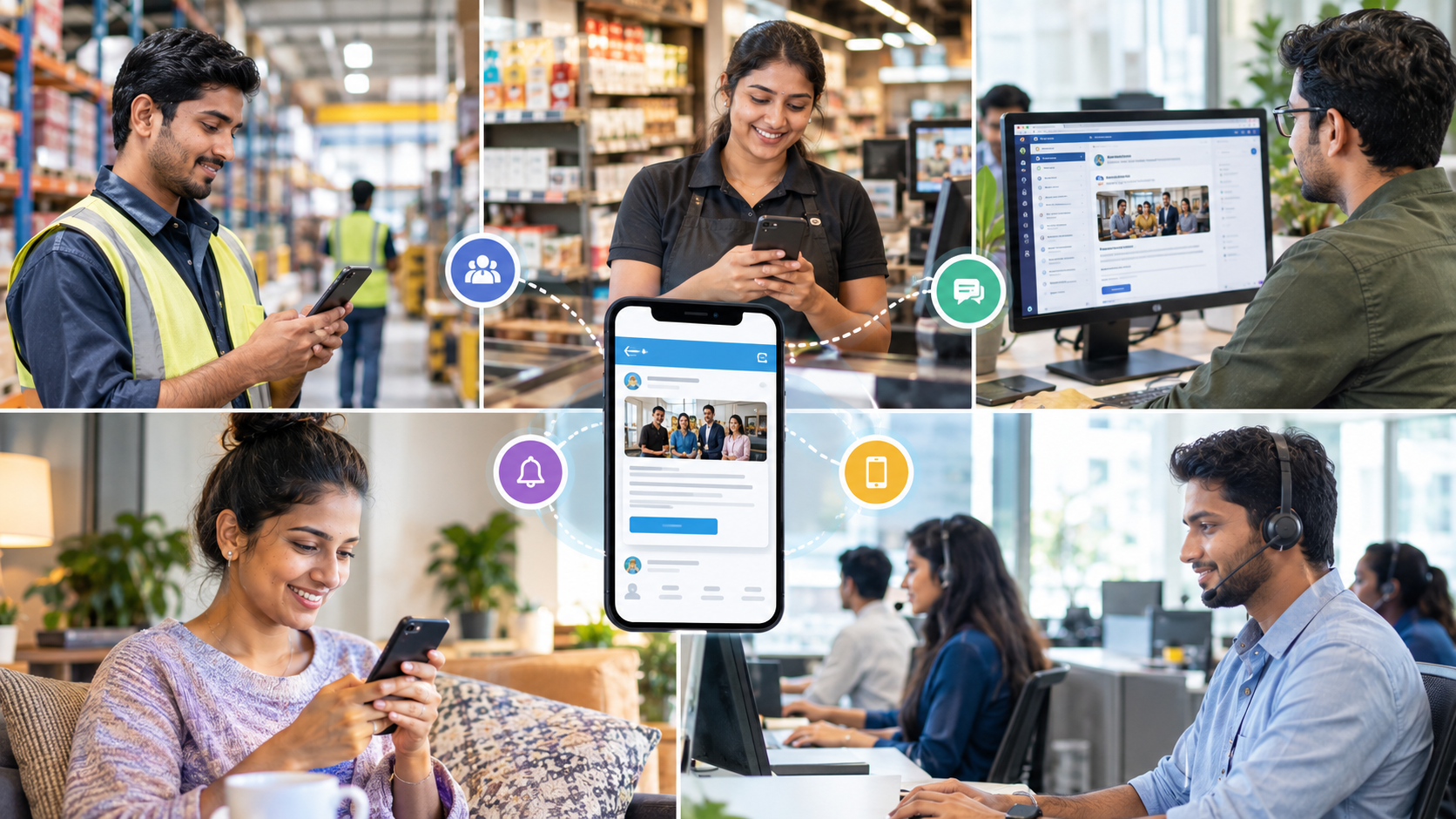
The most compelling case for digital communication at scale is who it can reach that traditional office-based communication simply cannot. BCG's research on the global workforce found that deskless workers, roughly 70 to 80% of the global workforce, are largely excluded from corporate email and intranet systems built around desk-based employees, leaving over two billion workers globally relying on notice boards and word of mouth for information that reaches their desk-based colleagues instantly. Mobile-first digital communication, apps, SMS, messaging platforms, is one of the only practical ways to close that gap at genuine scale.
Where Digital Communication Delivers the Strongest Engagement Impact
Consistency across a large or distributed organisation. A message delivered digitally reaches every location and shift at the same time, in the same form, removing the distortion that happens when information travels through multiple layers of verbal retelling.
Reach into frontline and deskless roles. Mobile-first channels reach retail, warehouse, field and shift-based employees who traditional email and intranet systems were never designed to include, closing an engagement gap that's often invisible to HR teams working primarily with desk-based data.
Speed during time-sensitive moments. A digital channel can deliver an urgent update in minutes rather than the hours or days it takes information to travel informally through a large organisation, which matters significantly during safety updates, crisis communication or fast-moving change.
Feedback and listening at scale. Digital pulse surveys, comment functions and recognition platforms let a large workforce be heard continuously, something that's practically impossible to replicate through in-person listening alone once an organisation passes a certain size.
Measurable engagement data. Digital channels generate genuine usage data, opens, clicks, participation, response rates, giving HR visibility into what's actually landing across a large workforce rather than relying on anecdotal impressions from whichever office leadership happens to visit most often.
Cost efficiency that scales. The marginal cost of reaching the 5,001st employee digitally is close to zero, a structural advantage no in-person engagement effort can match once headcount grows into the thousands.
Where Digital Communication Alone Falls Short
Digital reach isn't the same as digital sufficiency. Research on employee communication consistently finds that immediate supervisors remain the most trusted source of workplace information, which means digital broadcast, however well executed, still needs manager-level reinforcement to fully land. A well-designed app reaching every employee is a genuinely powerful engagement tool. It isn't a replacement for a manager who actually talks to their team.
Common Mistakes When Scaling Engagement Digitally
The most frequent mistake is building a digital communication strategy purely for desk-based employees and treating frontline reach as an afterthought, when frontline and deskless employees typically make up the larger share of a workforce, not the smaller one.
The second mistake is treating digital channels as one-way broadcast tools, missing the genuine advantage digital communication offers for listening and feedback at scale, not just message delivery.
The third mistake is assuming a digital rollout alone fixes engagement, when the strongest results come from pairing digital reach with manager enablement, not substituting one for the other.
How to Know If Digital Communication Is Actually Driving Engagement
Track usage and engagement data segmented by role type specifically, desk-based versus frontline, rather than an aggregate number that can mask a large, disengaged deskless population. Watch whether feedback channels are genuinely used, and whether digital reach is translating into the same participation and sentiment improvements across every part of the workforce, not just the desk-based segment that's easiest to measure.
Building Mass Engagement That Actually Works
ICE's Inform pillar is built to deliver consistent, scalable communication across an entire workforce, paired with Connect to keep the human, manager-level layer intact alongside digital reach. For more, see how HR can improve communication with employees on the ICE blog.
Follow ICE on LinkedIn, Instagram, Facebook, and YouTube for more HR and communication resources.