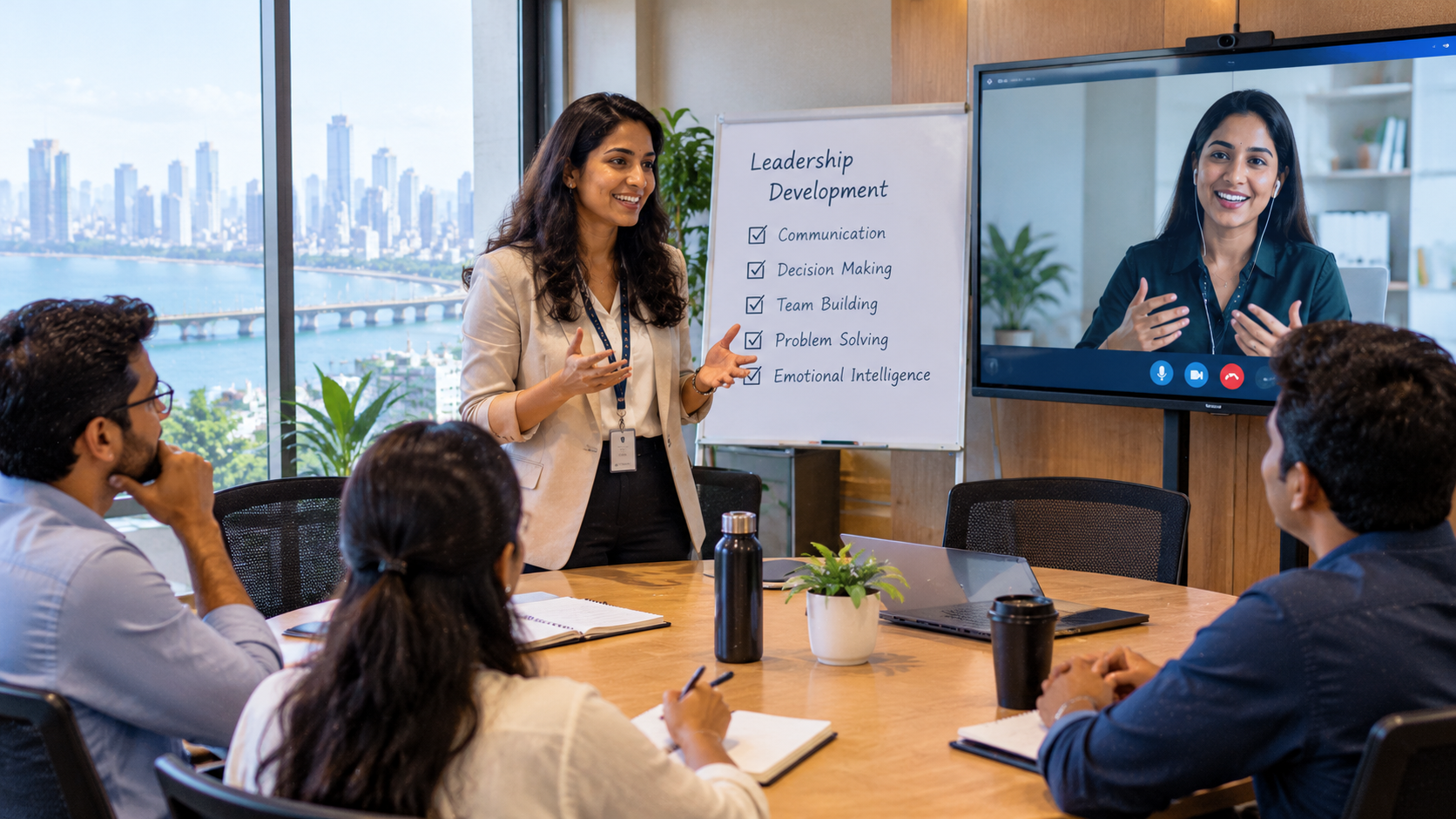
Corporate Leadership Training in Mumbai: Online vs In-Person, and Why Most Companies Should Blend
Corporate leadership training in Mumbai: online vs in-person. What the research says, when each works and how to blend them.
Mumbai HR teams planning leadership programmes keep hitting the same decision. In-person is richer but costs travel time across a city where a cross-town trip can take two hours. Online is flexible but easy to multitask through. The question of online vs in-person corporate leadership training in Mumbai has no universal answer, but the research gives clearer guidance than most vendors admit.
This guide explains what the evidence says, which skills suit which format, how Mumbai’s realities change the choice and how to build a blended programme. For the full overview, see our guide to corporate leadership training in Mumbai.
What the Research Says
Two bodies of evidence matter, and neither says “online is bad.”
On leadership specifically, a meta-analysis of 335 studies in the Journal of Applied Psychology found that leadership training works best when it uses a needs analysis, feedback, several methods with plenty of practice, spaced sessions, on-site delivery and face-to-face teaching rather than self-administered formats. The takeaway is that practice, feedback and live interaction matter more than the room itself.
On online learning in general, a widely cited US Department of Education meta-analysis found that classes with online elements performed modestly better on average than face-to-face instruction, with the advantage concentrated in blended formats, and the authors noted that those blended conditions often included extra learning time and materials, so the benefit should not be put down to the medium alone. That research covers students, mostly in education, not managers, so treat it as a pointer, not proof.
Taken together: well-designed blended programmes with practice and feedback have a strong evidence base, and the format matters less than whether people actually practise.
What Each Format Does Well
In-person
In-person sessions are strongest for skills that depend on reading people and practising under mild pressure: giving difficult feedback, handling conflict, running meetings and coaching. They also build relationships across a cohort, which keeps people accountable later. They suit sensitive topics and senior groups.
Live online
Live virtual sessions are strong for short practice clinics, discussion of cases and keeping dispersed cohorts connected. They save travel time and suit hybrid teams, multiple locations and refreshers.
Self-paced online
Self-paced modules are good for concepts, frameworks and short pre-work. They are weak on their own for behaviour change, since there is no practice with feedback.
Match the Format to the Skill
Giving feedback and difficult conversations. In-person or live online with role-play. Practice with feedback is essential.
Coaching and one-on-ones. In-person or live online, with practice in pairs.
Delegation and prioritisation. A mix: concepts online, application in a live session.
Managing change and communication. Live sessions with cases, plus on-the-job tasks.
Leading hybrid teams. Live online is appropriate, since participants are practising the format they will use.
Strategy and decision frameworks. Online pre-work plus a live discussion.
Team building within a leadership group. In-person.
What Mumbai Changes
Commute time. A half-day workshop can cost people three or four hours in travel. Online sessions or in-person sessions held in your own office on anchor days reduce that.
Monsoon disruption. In-person sessions between June and September need a virtual fallback.
Hybrid schedules. Hold in-person sessions on days the cohort is already in the office.
Multiple locations. Cohorts spread across BKC, Andheri, Powai, Thane and Navi Mumbai may find a central venue impractical, which favours live online with periodic in-person days.
Language. Practice in the languages your teams actually use is easier in a live setting, where facilitators can adapt.
Shift managers. Supervisors on rotating shifts need sessions at times that fit, and recordings of non-practice content.
How to Build a Blended Programme
A practical structure, using the research above:
Step one, pre-work online (30 to 45 minutes). A short video or reading on the week’s topic, plus a self-assessment.
Step two, live practice (half day in person, or 90 minutes live online). Role-plays, cases and feedback from facilitators and peers.
Step three, on-the-job task (one week). Each manager tries the skill with their own team, such as holding a feedback conversation or drafting a team agreement.
Step four, peer circle (45 to 60 minutes live online). Small groups share what happened and what they would change.
Step five, nudges and reinforcement. Short reminders, a manager check-in and a refresher after a month.
Space the cycles two weeks apart, over six to eight weeks, and hold at least a few in-person sessions, particularly the first and last.
A Sample Eight-Week Blended Plan
Week one is an in-person kickoff with a baseline. Weeks two and three are live online practice on one-on-ones and listening. Week four is an in-person session on feedback. Weeks five and six are live online on delegation and communicating decisions. Week seven is a peer circle and on-the-job task review. Week eight is an in-person review, action plans and a commitment to a peer group.
When to Choose Fully In-Person
Choose it for senior leadership groups working on trust and strategy, for sensitive or emotionally charged topics, for newly formed teams that need to bond and for programmes with a lot of live role-play. Keep a virtual fallback in the monsoon.
When to Choose Fully Online
Choose it for large, dispersed groups, for refreshers on skills people already have, for knowledge-heavy content and for tight budgets, ideally with live components for practice. Pure self-paced learning is rarely enough for behaviour change.
Questions to Ask a Provider
How much of the programme is practice with feedback? What is delivered live and what is self-paced? How do you keep online sessions engaging and stop people multitasking? Can you deliver in person at our Mumbai office, and online for other locations? How do you handle monsoon disruption? How will you adapt to our language mix? How will you measure behaviour change, not just satisfaction? What follow-up is included?
How to Measure Whether the Format Worked
Compare attendance and completion across formats. Look at practice-task completion, which shows whether skills were tried. Use before-and-after team feedback, short manager effectiveness pulse questions and engagement and retention in participants’ teams over two or three quarters. Do not rely on satisfaction scores alone, since a pleasant online session can still change nothing.
Common Mistakes
The most common mistake is choosing the format by cost alone. The second is a self-paced programme with no practice. The third is long, passive video sessions where people multitask. The fourth is ignoring Mumbai commute and monsoon realities. The fifth is leaving managers’ own managers out. The sixth is no follow-up. The seventh is measuring only satisfaction.
Where Communication and Engagement Fit
Leadership skills last when the workplace supports them. ICE’s Inform pillar supports leadership communication, and Connect builds shared experiences that help a cohort stay connected. For broader leadership development, choose a specialist provider and use the questions above to brief them. For related reading, see leadership communication: the skill that builds employee trust and why workplace culture isn’t built by policies alone. To discuss corporate leadership training in Mumbai and how communication can reinforce it, contact ICE.
Follow ICE on LinkedIn, Instagram, Facebook, and YouTube for more HR and culture resources.